
01SEP2026
How Does an SMM Panel Work?
Table of Contents
An SMM panel takes your order, charges a balance you loaded earlier, and hands the actual work to a delivery network it usually does not own. The dashboard runs the catalogue, the payment and the tracking. Someone further down the chain produces the followers, likes or views that land on your profile.
Most explanations stop at "you pay, they deliver." That skips everything that explains your real experience. Why an order sits pending for six hours. Why 2,000 views arrive, and 300 disappear in week three. Why the same service costs four times more on one site than on another.
So rather than describe the system in the abstract, this guide traces one order. One buyer, one Instagram Reel, 2,000 views, placed on a Tuesday night. We follow it from the click-through to the moment Instagram decides what it keeps.
If you want the plain definition of an SMM panel service and what people use it for, start with our guide on what an SMM panel is. This one goes under the hood.
Before the Click: The Row You Choose Decides Everything
Open any panel, and you scroll a list. Each row shows a number, a name, a price per 1,000, a minimum, a maximum and a paragraph of description.
The number matters more than the name. That number is the Service ID, and it is what the backend actually reads. Behind it sit:
- The supplier your order gets sent to
- The current rate
- The order limits
- The service type, which controls what the order form asks for
- Refill eligibility and how long the guarantee runs
- Any country or account-type restriction
Our buyer picks Service ID 1408. Instagram Reels Views, $0.34 per 1,000, minimum 100, maximum 500,000, described as instant start with no refill.
Service Type Changes the Form Itself
Panels run several service types, and each one asks for something different.
A default service wants a link and a quantity. That covers most of the catalogue.
A custom comments service wants a list of comments instead of a number. Paste twenty lines, and you ordered twenty comments.
A drip-feed or package service adds two fields, runs and interval. You are scheduling batches rather than placing one delivery.
A subscription service watches a username and creates orders automatically every time that account posts.
A poll service needs the exact answer you want voted for. A comment likes service needs the username of whoever left the comment.
Pick the wrong type and the form stops you before anything else happens.
Why Two Rows With Identical Names Behave Nothing Alike
Scroll far enough and you find six services all called some version of "Instagram Followers." They are not variations on one product. Each one points at a different supplier.
Service ID 1201 might cost $0.38, start instantly and shed 40 percent inside a month. Service ID 1633 might cost $2.10, take four hours to start and carry a 365-day refill. The names look almost identical. The outcomes do not.
Read the description. Somebody typed the name in a hurry. The description carries the terms.
Catalogues Shift Under You
Panels pull their catalogue from suppliers on a schedule, sometimes hourly. When a supplier kills a service, raises a price or changes a minimum, that change flows downstream automatically.
This explains a lot of small frustrations. A service you relied on last month vanishes. A price moves overnight. A saved Service ID inside someone’s automation stops matching anything at all.
The First Second: Six Checks Before Anything Happens
Our buyer pastes the Reel URL, types 2000 and clicks submit. Before the order exists, the panel runs through a short list.
- Does this service still work, or did an admin disable it?
- Does 2000 sit between the minimum and the maximum?
- Does the URL match the shape this service expects?
- Does the balance cover the charge?
- Did the buyer fill every field this service type requires?
- Does an active order already point at this same link and metric?
Fail any of these and the form throws an error. Nothing gets charged. Nothing gets recorded.
Now notice what these checks skip. They inspect the shape of the request, never its correctness. A properly formatted Instagram URL pointing at last week’s Reel instead of tonight’s passes all six. The views then land on the wrong post, and nobody can pull them back.
The Charge: Why Panels Hold Your Money in Advance
Nearly every panel runs a prepaid wallet. You deposit once, then spend down.
The reason comes down to arithmetic. Our order costs 68 cents. A card transaction on 68 cents burns more in processor fees than the order earns. So panels solve the payment problem once and deduct from the result many times.
Panel pricing runs per 1,000 units, which gives you:
charge = (rate ÷ 1000) × quantity
At $0.34 per 1,000, an order of 2,000 costs $0.68. That amount leaves the balance the instant the panel accepts the order.
Accepting Is Not the Same as Starting
The deduction proves one thing only. The panel wrote your order into its database. Routing happens next, and routing fails often enough to matter.
Failure does not reverse itself instantly either. The panel has to receive a failure signal, process it, then credit the balance back. On some panels, a scheduled job handles that step, which means your refund waits for the next run.
Partial Orders Refund the Gap, Not the Whole Thing
If delivery stalls at 1,400 of 2,000, the panel returns only what it failed to deliver:
refund = (rate ÷ 1000) × remaining quantity
Six hundred undelivered views at $0.34 per 1,000 credits about 20 cents. It goes back to your panel balance, not to your card. Almost every panel handles it this way. If you top up through a local method, our guide on paying with bKash, Nagad and Rocket walks through how deposits and balances behave on this side.
Three Records, Three Different IDs
When something breaks, this trips people up more than anything else.
Your payment sits with the gateway. Your order sits in the panel database under one ID. The supplier’s version of that same order sits somewhere else entirely, under a different ID.
The three connect, but they never mirror each other. A gateway can confirm your payment while the panel order never got created. A panel order can exist while the supplier never received it. Support asks for the Order ID first because that single number runs through the middle of the chain.
The Handoff: How Far Your Order Travels
Once the order clears validation, the panel decides who fulfils it. Four patterns cover almost everything you will encounter.

- The panel delivers it itself.Rare. This describes a main or master panel, one that controls its own sources rather than renting them.
- The panel forwards to one supplier.Each Service ID maps to one service at one company. Clean, predictable, easy to troubleshoot.
- The panel forwards to whichever supplier a rule picks.Price, current stock, recent success rate, country requirement, or an admin flipping a switch. Two identical orders an hour apart can land at two different companies.
- The panel forwards to another panel, which forwards again.Reseller chains run three and four deep. You see one dashboard. Your order passes through several.
Chain length shapes your experience more than most buyers realise.
Each hop adds a margin, so the same underlying service costs progressively more the further down you buy. Each hop adds sync delay, so status updates reach you later. And each hop puts distance between you and anyone who can actually investigate. A panel sitting three steps from the source cannot diagnose a delivery failure. It forwards your ticket upward and waits, exactly like you do.
The Language Panels Use to Talk to Each Other
Panels forward orders through an API, and the industry settled on one shared format years ago. Everyone calls it API v2.
It looks primitive. One endpoint. A POST request carrying form-encoded fields. An action parameter naming what you want. JSON coming back. No REST paths, no OAuth, no versioned resources.
That simplicity explains why the reseller market grew so fast. Any panel connects to any supplier in an afternoon, because they all speak the same eight commands.
Our order enters this system as a single add call carrying the API key, service 1408, the Reel URL and the quantity 2000. The supplier answers with its own order number, which the panel files alongside its own.
Your Order Carries Two IDs, and You See One
The panel keeps its Order ID and the supplier’s Order ID side by side in the same database row. Your dashboard displays only the first. Support sees both, which is why an agent can tell you things the interface never will.
Status Arrives on a Schedule, Not in Real Time
Panels poll. A background job wakes every few minutes, asks the supplier about every open order, and writes the answers back.
So a gap always sits between the supplier finishing and your dashboard admitting it. Reloading the page changes nothing, because your browser never asks the supplier anything.
The Supply Side: Who Actually Delivers 2,000 Views
Here sits the question panels answer least honestly, and it drives everything you care about. Retention. Drop rate. Price. Risk.
Two conclusions fall out of this.
The word "real" carries no technical weight. A click farm worker qualifies as a real human on a real phone. That person still holds zero interest in your Reel, will never watch the next one, and moves a number without moving anything underneath it.
Price tells you more than any label. Manufacturing a bulk account costs a fraction of a cent, so panels sell its output for almost nothing. Reaching a genuinely interested viewer costs real money, so nobody sells that for pennies. When a service sits far below the rest of its category, sourcing paid for the discount.
Regulators have begun treating parts of this as more than a policy problem. The FTC finalised its Consumer Reviews and Testimonials Rule in August 2024, and the rule bans buying or selling fake indicators of social media influence, which it defines to include followers and views generated by bots or hijacked accounts, in cases where the buyer knew or should have known and used them to misrepresent commercial influence.
The Next Few Hours: How Delivery Behaves
Once the order is accepted, delivery begins in accordance with the rules set by the service and supplier. Start count, remains, drip feed, speed, and target availability all affect how the order behaves over the next few hours.
The Start Count Anchors Everything
At the moment the panel accepts the order, it photographs your current number. Our Reel sits at 412 views. That figure becomes the start count.

Everything afterwards gets measured as movement away from 412, never as an absolute. So if the Reel picks up 90 organic views during delivery, some systems fold those into the total. And when a refill request comes later, this is the number it measures against.
Write it down yourself before you submit. It hands you an independent record that nobody further up the chain can quietly revise.
Remains Counts Down
The remains field tracks the distance between what you ordered and what the supplier reports delivering. Remains hits zero and the order flips to Completed. Delivery halts with remains above zero and the order flips to Partial.
Drip Feed Builds a Schedule, Not a Slower Order

Drip feed does not stretch one delivery. It splits your request into separate runs and fires one every interval you set. Twenty runs of 100 views at a 30-minute interval means twenty deliveries spread across the next nine and a half hours.
Because each run stands alone, a drip-feed order succeeds in parts and fails in parts. Runs one through six complete. Run seven fails because stock dried up. The order history looks strange and behaves exactly as designed.
Speed Describes a Ceiling

A service promising 10K per day tells you what the supplier pushes at most, never what you receive. Queue depth, competing orders and current stock set the real pace. Read every speed figure as an upper bound somebody hopes to reach.
A Private Profile Ends the Order
Delivery aims at a public URL from outside. Nothing logs in anywhere. So the moment a profile flips private, a post disappears or a username changes, the delivery system loses the address it was working against.
Most orders stop dead at that point. They cannot resume, because the panel can no longer verify what landed against a target it cannot read.
Reading Your Dashboard Without Guessing
Your panel does not invent statuses. It copies whatever the supplier reports and shows you the result.
- Pending.The order exists. Nobody has picked it up yet. This points at a queue, not an error.
- In progress.The supplier accepted it and started work. This promises nothing about finishing.
- Completed.The supplier reported remains at zero. This says nothing about whether Instagram counted it.
- Partial.Delivery stopped short and the undelivered value returns to your balance. You did nothing wrong.
- Cancelled.The order never started, or something stopped it. The refund may still sit in a queue.
- Refilling.A refill request went through and waits its turn. It does not guarantee the drop gets replaced.
One line clears up most of what people bring to support: Completed describes the delivery system, not the social platform.
Three Weeks Later: What the Platform Does About It
Nothing in this entire process asks Instagram, YouTube or Facebook for permission. Delivery happens from outside, and the platform reviews the result whenever it chooses.

YouTube states its position plainly. Its fake engagement policy forbids anything that artificially raises views, likes, comments or other metrics, whether through automated systems or by pushing videos at people who never asked for them. Traffic it judges artificial does not get counted and can earn a strike, and subscribers flagged as spam drop straight out of your totals. YouTube also holds you responsible for whoever you hire, so a service you paid for can cost you the channel.
Meta cleans at a scale most people underestimate. Facebook has actioned somewhere between roughly 700 million and 1.1 billion fake accounts in recent quarters, and Meta’s own filings still estimate that around 5 percent of monthly active users count as false accounts. When those accounts disappear, whatever they did to your page disappears with them.
That mechanism explains drops completely. Nothing expired. Nothing decayed. A platform swept the accounts that delivered your order, and your number slid back toward where it began.
What a Refill Actually Does
Refill does not top you up out of goodwill. The system compares your current count against the start count plus whatever got delivered. If the shortfall lands inside the guarantee window, and the service carries refill eligibility, it queues a fresh delivery to close the gap.
Which explains why refill fails in such predictable ways. Past the window, nothing happens. Service marked no-refill, nothing happens. Changed the username or deleted the post since ordering, nothing happens, because the comparison lost its anchor.
Our buyer chose a no-refill service to save eleven cents. Three weeks on, 2,000 views had settled at 1,730. That gap stays open permanently.
When It Breaks: Find the Layer Before You Open a Ticket
Almost every support conversation reduces to one question. Which part failed? Five candidates, and each one wants a different response.
- The form rejected it. Panel-side validation. Fix the quantity, the URL format or your balance, then resubmit.
- It sits Pending long past the stated start. Routing. The supplier went offline, an API key expired, or the Service ID stopped matching anything. Send the Order ID and let the panel re-route or refund.
- It stalled halfway or landed Partial. Supplier-side. Confirm your target stayed public, then open a ticket with the Order ID.
- It started, then failed. Almost always your side. A profile went private, a post got deleted, or a username changed mid-delivery.
- The count rose, then fell days later. Platform-side. Request a refill if the service allows one. If it does not, nobody in the chain can help.
Reloading the dashboard solves none of these. Naming the layer solves most of them, and it explains why every competent support agent asks for your Order ID before anything else.
The Limits Nobody Puts in the Marketing
A panel moves a number. Trace the whole process end to end, and the boundaries become obvious.
- It cannot force a platform to count or keep what got delivered
- It cannot touch the algorithm, the recommendation system or a monetisation review
- It cannot promise retention, because it does not own the accounts doing the work
- It cannot reach a private, deleted or renamed target
- It cannot turn a metric into a customer
Those limits live in the architecture. No panel, however well run, engineers around them.
What This Should Change About How You Order
Understanding the machine should shift a handful of habits.
- Record the Service ID, not just the service name. It identifies what you actually bought.
- Write down your start count before you submit. It becomes your only independent evidence.
- Run one small test at the exact Service ID and link type you plan to scale.
- Check the refill window before you pay, not after the number falls.
- Keep the target public and untouched from submission through to completion.
- Reach for drip feed whenever a service offers it.
- Carry the Order ID into every support conversation.
- Judge a panel on its service descriptions and its ticket replies, not its homepage design.
If you are deciding which panel deserves a real budget, our guides on choosing the best SMM panel and on cheap versus premium panels work through that decision properly.
Frequently Asked Questions
Where does my order go after I click submit?
Into the panel database first, then outward. The panel validates the request, deducts the charge, records a start count, and forwards the job to whichever supplier that Service ID points at. On most panels the delivery happens somewhere else entirely, one or more companies down the chain.
Why does the same service cost different amounts on different panels?
Because the panels sit at different distances from the source. Every reseller in the chain adds a margin, so a panel buying direct charges less than a panel buying from a reseller who bought from the source. Support quality, refund policy and payment fees also get priced in.
What is the start count and why should I care?
It is your number at the moment the order was accepted, and every measurement afterwards works from it. It decides what counts as delivered, and it becomes the reference point for any refill request. Saving it yourself gives you evidence nobody else controls.
Does an SMM panel ever need my social media password?
Never. Delivery aims at a public URL from outside the platform, so no step in the process touches your account. A panel asking for a password, a recovery email or a two-factor code wants the account, not the order.
Why did my order stay Pending all night?
Usually queue depth at the supplier. Sometimes routing: the supplier dropped offline, an API key expired, or the Service ID no longer matches anything on their side. Past the stated start time, send the Order ID to support instead of placing a second order.
What happens to my money when an order goes Partial?
The panel keeps payment for what got delivered and credits the rest to your balance, calculated on the undelivered quantity at the same rate. It returns as panel credit rather than to your card, which is standard across the industry.
Final Thoughts
An SMM panel works as an order desk bolted onto a supply chain it mostly rents. It reads your request, deducts your balance, forwards the job outward, and repeats back whatever the supplier tells it. That is the whole machine.
Trace one order through it and the confusing parts stop being confusing. Pending points at routing. Partial points at stock. A number sliding three weeks later points at the platform, and no ticket ever written changes that outcome.
Record your Service ID, save your start count, read the description, and start small enough that a bad service costs you a dollar rather than a month. Everything else follows from knowing which part of the chain you are actually talking to.
Share this on social media



Recently Posted Blogs
09OCT2026
How to Become an SMM Main Provider Instead of a Reseller?
Becoming an SMM main provider means moving from buying services for resale to supplying services that other resellers, agencies, or panels can depend on. You need reliable service capacity, a wholesale ordering system, clear service rules, tested delivery, and a process for handling problems before you can scale.
Read More
07OCT2026
How to Calculate Profit Margins in the SMM Panel Reselling Industry?
A 100% markup on an SMM service can leave you with a net margin of about 42% once funding and payment fees are counted, and less again after refunds or uncovered drops. The gap between those two numbers is what this guide calculates.
Read More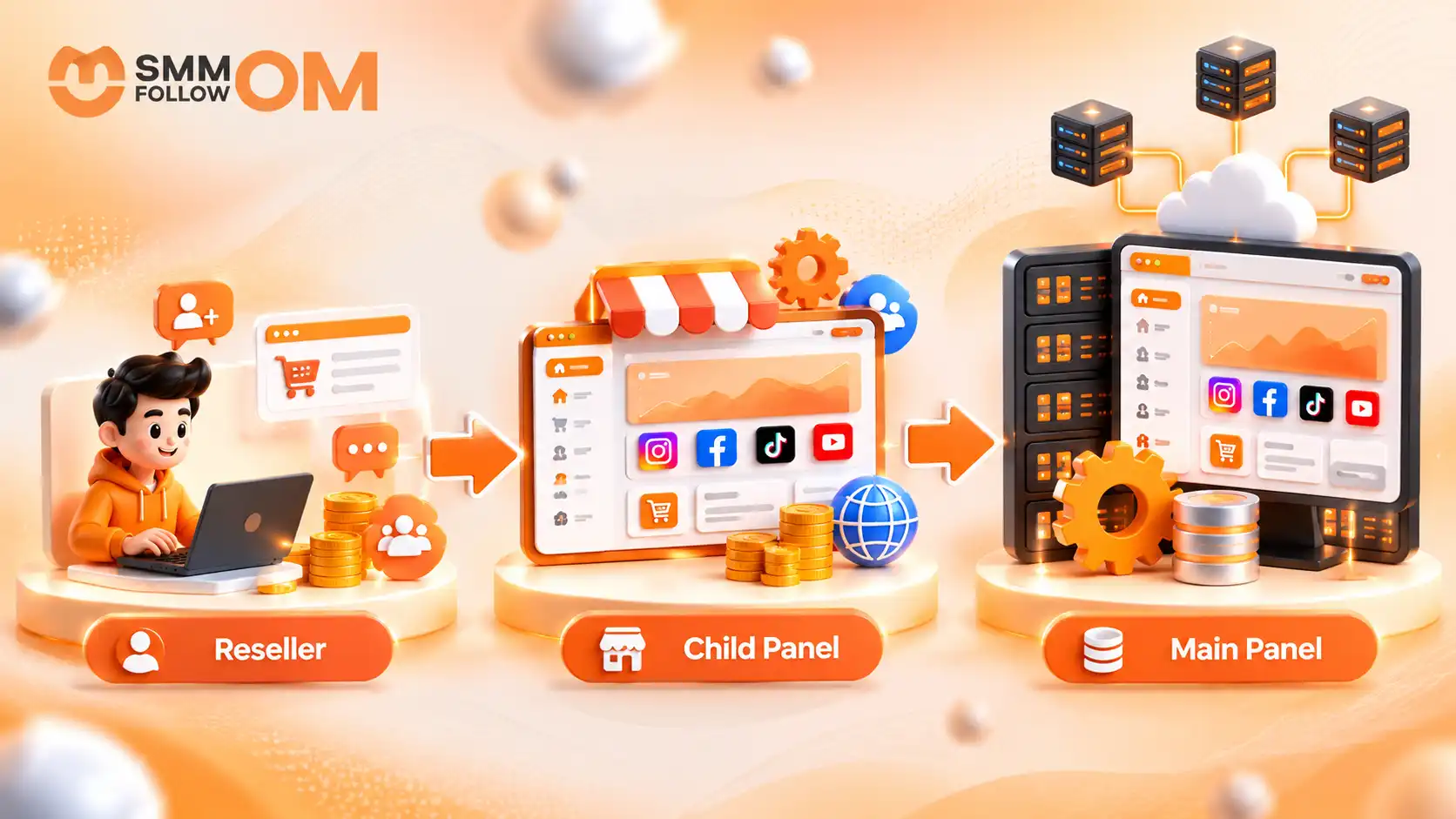
05OCT2026
Main Panel vs Child Panel vs Reseller in SMM: What's the Difference?
In the SMM panel business, a reseller sells another panel's services, a child panel rents a branded storefront from a parent panel, and a main panel runs its own panel software and supplier connections.
Read More