22OCT2026
How to Start an SMM Reseller Business in Bangladesh?
Table of Contents
To start an SMM reseller business in Bangladesh, you buy social media services from a supplier panel at reseller rates, resell them to local customers at your own price in BDT, and keep the difference.
Facebook’s leads show up in traffic too.
Facebook takes 78.63% of social media referral traffic in Bangladesh, YouTube 15.32%, and Instagram just 2.47%. That gap is the practical part for a reseller. A catalogue built around Facebook services will match local demand far better than one built around platforms that look bigger globally.
1. Decide How You Want to Resell
Start by choosing the type of reseller setup you need.
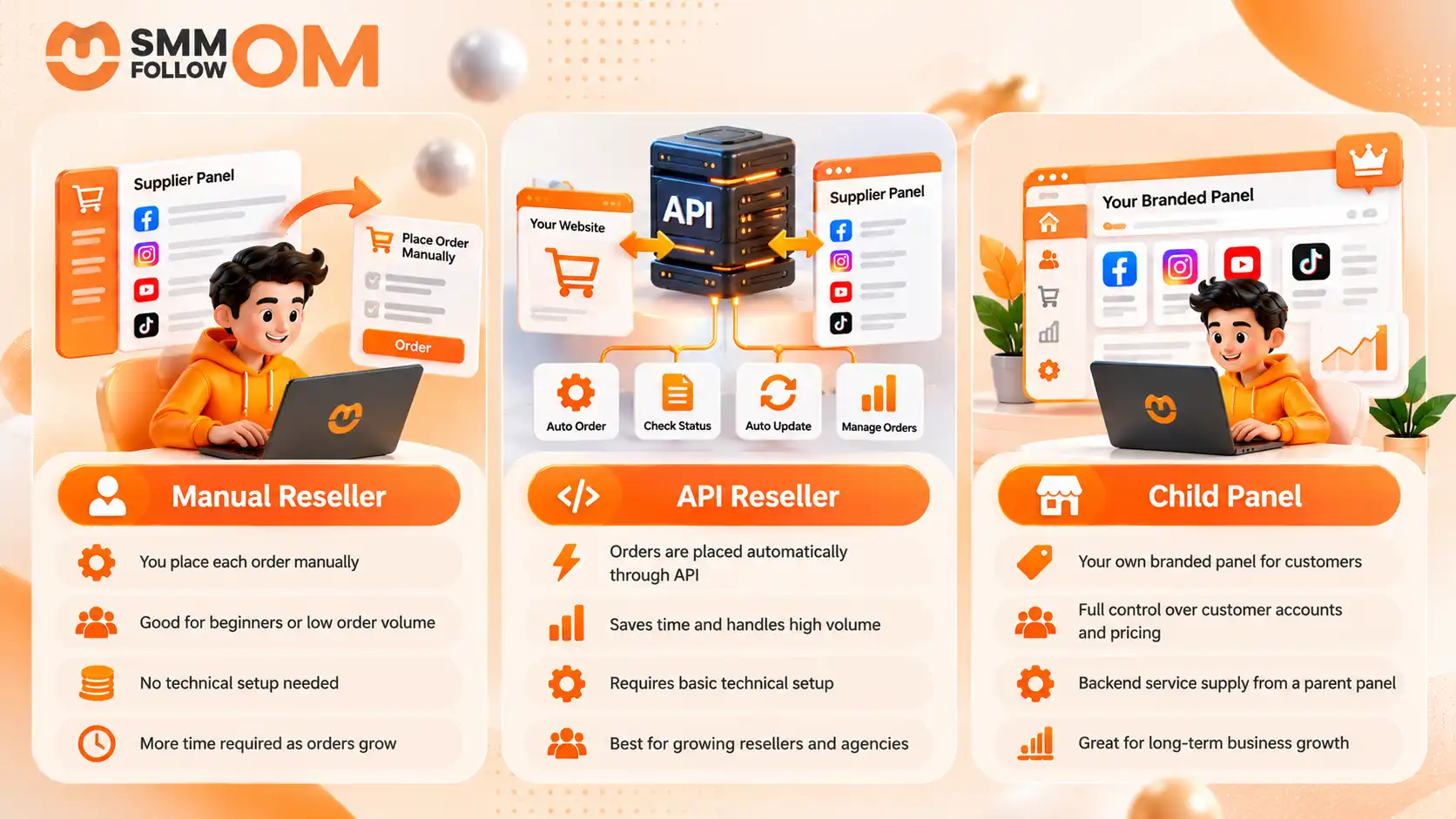
There are three common options:
- Manual reseller account:You take the customer's order and place it yourself through your supplier's dashboard. This works well when you are new or only handling a few orders.
- API reseller:Your own website sends orders to the supplier automatically. This makes more sense when manual order entry starts taking too much time.
- Child panel:You operate a branded panel for your customers while another panel handles the service supply behind it.
If you are starting from zero, manual reselling is usually enough.
You can learn how service IDs, quantities, links, order statuses, refills, and balances work without spending money on a more complicated setup.
Choose API or child-panel reselling only when you already know why you need it.
For example, if you are handling five orders a week, manual ordering is easy. If you are handling 100 orders a day, entering each one yourself becomes a problem.
Automation, branding, and cost all move when you switch models, and the three setups compared side by side shows what each one actually demands.
Make that decision based on your actual order volume, not on what looks more professional.
2. Find a Provider You Can Actually Resell From
Do not search for the cheapest SMM panel and stop there.
You are going to depend on this provider after your customer has already paid you. A service that costs slightly less can become expensive if it keeps failing or creating refund requests.
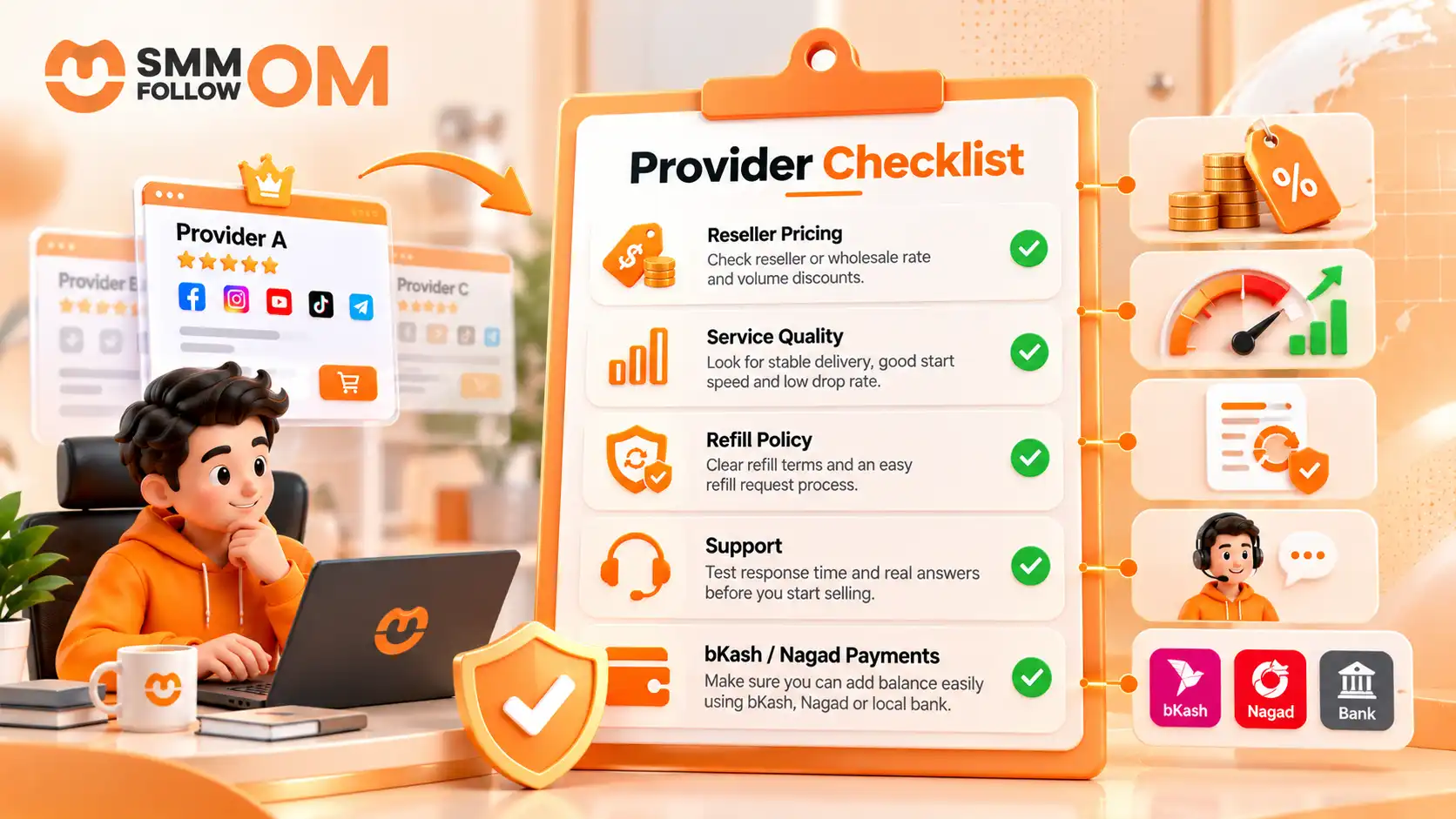
Open several panels and compare them side by side.
Check whether they offer reseller pricing, how clearly they describe their services, what refill terms they provide, and whether their support team answers real questions.
Payment access matters as well.
Choose a provider that makes it easy to add balance from Bangladesh. Support for bKash, Nagad, local cards, or bank payments can save you from depending on difficult international payment methods.
Facebook takes the largest share of social media activity in Bangladesh, so a reseller targeting local businesses should check the provider’s Facebook services carefully before worrying about a huge catalog of smaller platforms.
If most of your future customers want Facebook and Instagram services, a provider with excellent Telegram services but weak Facebook coverage is not a good match for you.
Before choosing one, answer a simple question:
Can I confidently sell this provider's services to another person and deal with the problem if an order goes wrong?
If the answer is no, keep looking.
Working through a proper checklist before you trust a panel takes an evening and saves the refund conversations later.
3. Register and Get the Reseller Rate
Once you choose a provider, create an account. Do not assume the price you see after registration is already the reseller price. Some panels use one rate for everyone. Some have a separate reseller program. Others lower the price when your order volume increases.
After logging in, look for a section called Reseller, Wholesale, or something similar.
If nothing is shown, contact support. You can send a simple message:
I plan to resell your services in Bangladesh. Do you offer reseller or wholesale rates? If so, what do I need to qualify?
Ask this before you build your own price list.
Suppose the public price of a service is ৳120 per 1,000, but approved resellers can buy it for ৳90. If you start selling based on the ৳120 cost, your prices may be much higher than necessary.
Also ask whether the reseller rate changes when your monthly spending increases.
Keep the provider's answer somewhere you can refer to later. Pricing rules can affect how you structure the business.
4. Add a Small Balance and Test Before You Sell
Do not deposit ৳20,000 just because you plan to become a reseller. Start with enough money to test a few services.
Choose the exact services you are thinking about selling and place small orders first.
For example, if you want to sell Facebook page likes, do not only test Facebook post likes because they happen to be cheaper. Test the exact service you plan to put in front of customers.
Watch the order from beginning to end.
Notice when it starts. Check whether the full quantity arrives. Look at whether the count changes after a few days. If the service includes refill protection, learn how the refill request works.
Also test the provider when something does not go perfectly.
A good support team becomes much more important when you have a customer waiting for an answer.
Keep a simple note for every test:
Service name → provider cost → start time → delivery result → refill result → would you sell it?
After testing five services, you may decide only three are good enough for your customers. That is useful information.
You now have a small service list you understand instead of a huge catalog you have never used.
5. Work Out Your Selling Price in BDT
Now you know what each service really costs you. Use that cost to set your customer price. Do not start with, “What is everyone else charging?”
Start with your own numbers.
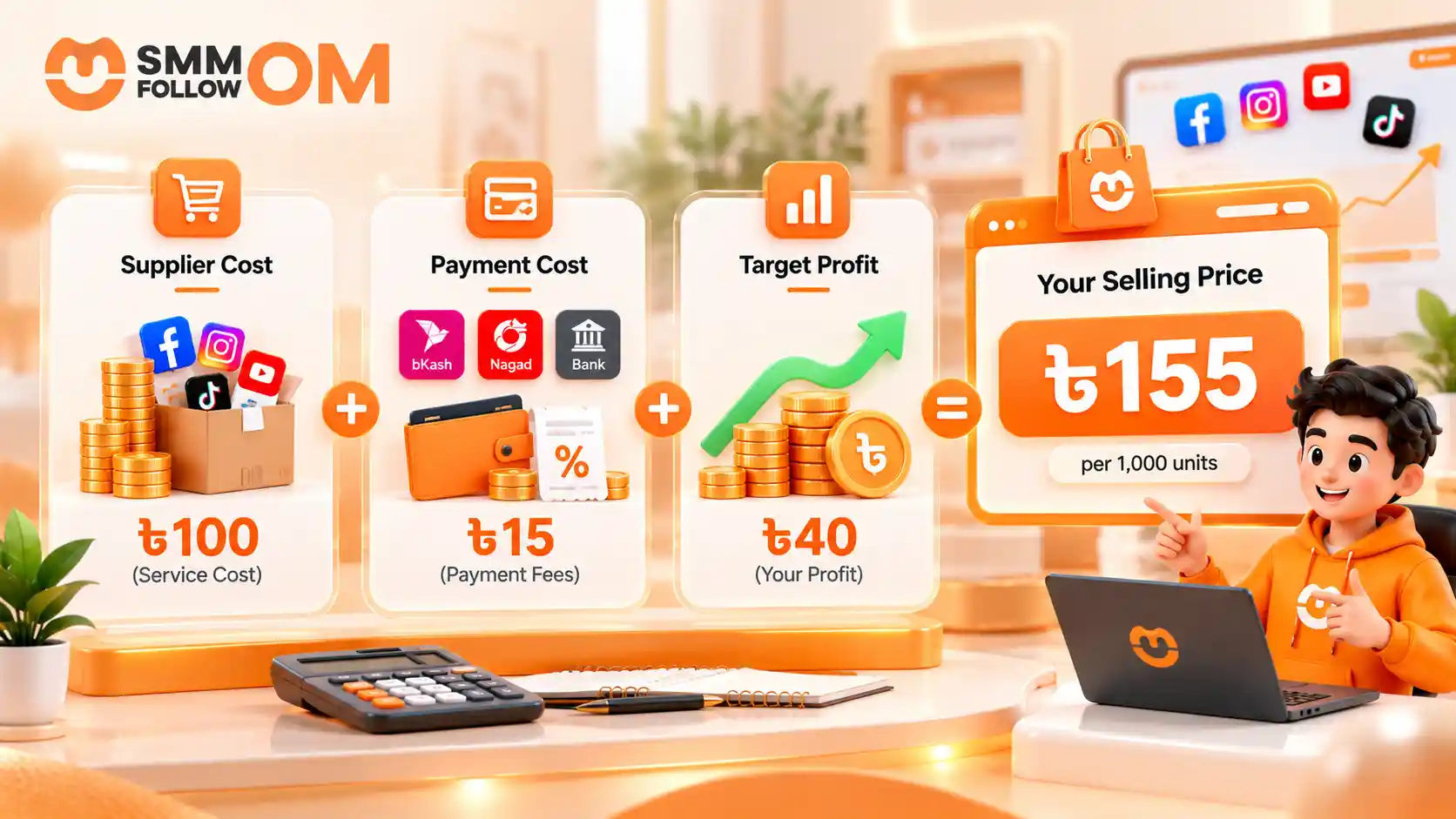
Suppose a provider charges you ৳100 per 1,000.
If it costs you around ৳15 to receive and withdraw that payment, and you want at least ৳40 from the order:
৳100 + ৳15 + ৳40 = ৳155
You might round that to ৳160 per 1,000. Work out your own figure, because bKash send money, cash out, and merchant payment all cost different amounts.
Now you know why the price is ৳150. You are not guessing. Do the same calculation for each service you plan to sell. Do not use the same percentage markup everywhere either.
A service that creates frequent support work may need a larger margin. A common service with many competing sellers may work with a smaller one.
The full version of this sum adds operating cost and a refund allowance on top. Reseller margins, worked out properly, have the complete formula and show which services carry the thinnest ones.
Keep a private price sheet with four columns:
Customer A | bKash TXN8X21 | ৳700 selling price | ৳500 supplier cost | Order ID 184572 | ৳200 profit
Update it when your provider changes its price.
Where Your First Customers Actually Are?
Your early orders will almost always come from people who already pay for online visibility. In Bangladesh, that means Facebook-first sellers: F-commerce page owners, marketplace sellers, local service businesses, and small creators building a following.
Facebook groups for local sellers are usually the first place to find them, because those groups already discuss page reach, ad cost, and engagement. Join as a participant before you post anything about your own service.
Start with one platform and one service you have actually tested. A reseller who can reliably deliver Facebook page likes is more useful to a local business than one offering forty services they have never ordered.
6. Take Your First Order and Resell It Properly
Once the service and price are ready, you can take a customer order. Suppose someone wants 2,000 Facebook page likes.
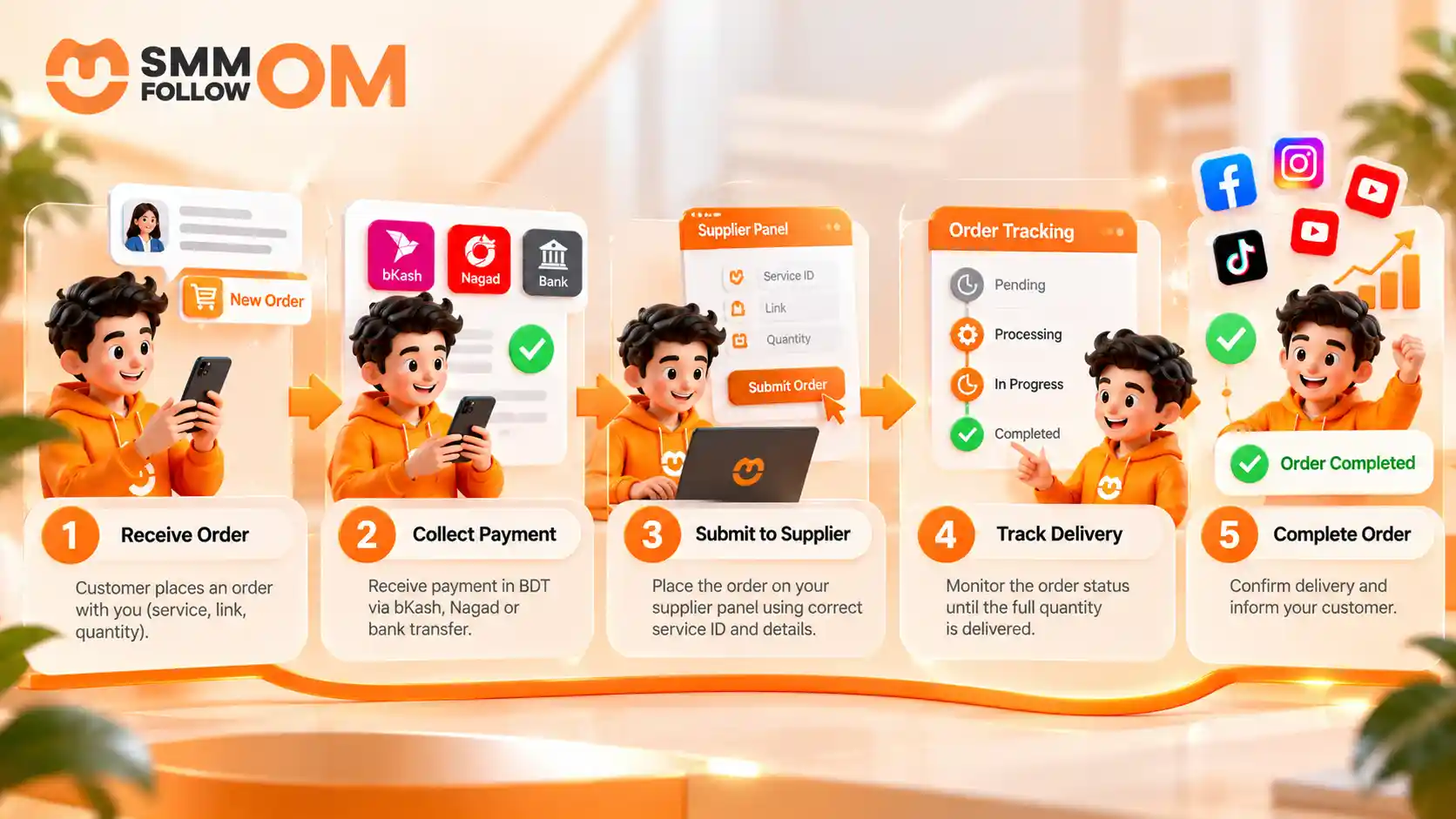
First, check which supplier service you are going to use. Then confirm the quantity and the exact link required for that service.
Collect the customer's payment before submitting the order unless you have another payment arrangement with them.
Now go to your supplier panel.
Select the service, paste the correct link, enter 2,000 as the quantity, and review everything before pressing the order button.
A wrong link can turn a profitable order into a loss. After submitting it, save the supplier's order ID. Do not simply tell the customer, “Order placed,” and forget about it. Check the status until the order reaches the expected result.
Imagine the numbers look like this:
Customer pays you: ৳700
Supplier charges you: ৳500
Your gross difference: ৳200
If the customer later reports a drop and the service includes refill, you can use the saved order ID to check eligibility with your provider.
This is the basic reseller cycle:
Receive order → collect payment → submit to supplier → track delivery → keep your margin
Once you can complete that process smoothly several times, you have the foundation of a real reseller operation.
7. Set Up Payments and Records for Your Reseller Business
Once customer orders start coming in, keep the payment and supplier details in one place. This becomes especially important when you receive money through bKash, Nagad, bank transfer, or other local payment methods.
For every order, save the customer’s payment reference before you submit anything to the supplier. Then add the provider order ID beside it. This makes it much easier to trace an order when a customer asks about delivery, a refill, or a refund.
A simple spreadsheet is enough at the beginning.
Keep all amounts in BDT in your own records, even when your supplier charges in USD. Record the converted supplier cost at the time you place the order. Otherwise, exchange-rate changes can make your profit records inaccurate later.
At the end of each week, compare the money customers paid with your actual supplier spending. You will quickly see which services are making money and which ones leave very little after payment charges and other costs.
You do not need accounting software on your first day. A clean spreadsheet with payment reference, supplier order ID, cost, selling price, and profit is enough to keep the reseller side organized.
8. When Manual Orders Stop Being Manageable
An API connects your reseller website with the supplier panel, so customer orders go to the provider without you entering them one at a time. It can also pull balance and order status back automatically.
Before using one, make sure you already understand service IDs, balance checks, price changes, partial orders, cancellations, and refill requests. An API will submit a wrong order just as fast as a right one.
Smmfollowom offers reseller API access without a separate API fee as of October 2026, and its API supports order placement, balance checks, and order-status tracking. Check the current terms in your panel account before building anything against it.
Do You Need a Trade License to Become an SMM Reseller in Bangladesh?
Yes, once you are running the SMM reseller activity as a business, you should have a trade license for it. BIDA's business guide states that a trade license is required for businesses operating in Bangladesh.
The license is issued by the local City Corporation, Municipality, or Union Parishad, depending on where your business is based.
For example, a reseller operating from Dhaka would normally apply through the relevant Dhaka City Corporation.
As of October 2026, DNCC trade licenses are issued under Section 84 of the Local Government (City Corporation) Act, 2009 and the Model Tax Schedule, 2016. Confirm the current schedule with your own City Corporation before applying, since fee categories are revised by fiscal year.
When applying, you may need documents such as your NID or passport, proof of business address, and other documents requested for your business type. BIDA also notes that a trade license is generally issued for one year and needs to be renewed each fiscal year.
For an SMM reseller, describe the actual service you provide when applying rather than guessing a business category. Your local authority can confirm which trade-license category fits an online social media or digital service business.
A trade license also does not replace your tax responsibilities. As the business grows, check whether you need an e-TIN, BIN, VAT registration, or other tax compliance through Bangladesh's National Board of Revenue.
FAQs
Can You Resell SMM Services to Customers Outside Bangladesh?
Yes. You can run the business from Bangladesh and still serve customers in other countries. The main difference is payment and pricing.
For overseas customers, you may need to quote prices in USD or another currency. Keep your own accounts in BDT as well so you can see the actual profit after currency conversion and payment fees.
Should You Use a Personal bKash or Nagad Account for Customer Payments?
For occasional testing, people may start small, but regular business payments are better handled through an appropriate merchant or business payment setup.
This gives you clearer transaction records and makes it easier to separate customer payments from personal spending. Check the current requirements of the payment provider before setting it up.
What Happens If Your Supplier Removes a Service?
Stop accepting new orders for that service until you have a replacement.
Do not quietly move customers to another service with different speed, refill terms, or quality. Test the replacement first, update your price if needed, and change the service description before selling it again.
Should You Give Regular Customers Credit?
Be careful with this in the beginning.
A customer may ask to place an order now and pay later, but the supplier still deducts money from your balance immediately. That means you are financing the order yourself.
Start with prepaid orders. Consider credit only after you know the customer well and can afford the risk.
Should Customer Money and Supplier Balance Be Kept Separate?
Yes. Treat them as two different things.
Money received from customers is business revenue. Money sitting inside an SMM panel is working balance that you use to fulfill future orders.
Keeping them separate makes it much easier to see whether the business is actually profitable or whether you are simply moving money between accounts.
Conclusion
You do not need to build a full SMM business on day one. Start with a few services, understand how the orders behave, and only add more when you know what is actually worth selling.
If you want to start reselling without setting up everything from scratch, smmfollowom’s reseller option gives you a simpler entry point. You can use a regular account, access reseller pricing, and sell services at your own rate.
The useful part is that you can start small and learn the process first. Once the orders, pricing, and margins make sense, you can decide whether to stay manual or move into a bigger reseller setup later.
Share this on social media


Recently Posted Blogs

19OCT2026
How Much Does Facebook Reels Pay Per 1,000 Views?
You can earn $0.02 to $0.20 per 1,000 views, with many estimates closer to $0.05 to $0.10 per 1,000 Reel views. Numbers above $1 per 1,000 views almost always come from longer videos or a US finance-style audience, not from ordinary Reels. The variation depends on your niche and country. Also, higher numbers may mix Reels earnings with longer-video ad earnings, so they aren't always a good estimate for Reels alone.
Read More
17OCT2026
How to Increase Facebook Followers in 2026: 12 Practical Ways That Actually Help
Increasing Facebook followers is no longer just about posting often. Facebook recommends content based on signals such as what people watch, like, comment on, and show interest in. That means growth depends more on who sees your content, why they visit your Page, and whether they want to follow it.
Read More
15OCT2026
How to Improve Your Facebook Business Page: 13 Practical Steps
Facebook is still the largest social platform in the world, with over 3 billion monthly users at Meta’s last published count. That reach is why the Page itself needs to work, not just the posts you put on it.
Read More