
11OCT2026
How Can an SMM Reseller Build Passive Income Without Their Own Panel?
Table of Contents
An SMM reseller builds passive income by handing the repeated parts of every sale to automation: a chatbot takes the order, a supplier API places it, prepaid credit removes payment checks, and alerts bring only the problems to you. The result is semi-passive, not hands-off. Once it runs, a reseller handling 30 orders a day spends minutes on the business instead of hours.
Is SMM Reselling Ever Truly Passive?
No. The accurate word is semi-passive. Software can take over the chat, the order entry and the status questions, but four problems still need a person:
- A supplier raises a rate, and a bot with fixed prices keeps selling at the old one, while a bot that syncs prices passes the jump straight to customers.
- A service that worked last month starts dropping or stalling.
- The supplier's API stops responding, and orders pile up unsent.
- Your supplier balance runs out while customers still hold credit with you.
None of these happen every day, but each one costs money when nobody is watching. So the aim is not to disappear from the business. It is to let normal orders move without you while the unusual ones reach you fast.
This guide is written for resellers who sell through Telegram, WhatsApp or Messenger and buy from a supplier panel, without a panel of their own.
Where Does a Reseller's Time Actually Go?
A manual sale runs through the same loop every time. A customer messages you and asks for a price. You send the price and your payment details, they pay, and you check that the money arrived. Then you ask for the link and quantity, open your supplier's panel, find the matching service and place the order. A few hours later, the customer asks how it is going, and you check again.
Each step is small, but they add up. If one order takes about five minutes from first message to last update, 30 orders a day is two and a half hours of copying, checking and replying. Add the people who ask for a price and never buy, and the real number is higher.
Look at that loop closely and only two moments need your judgment: a payment that looks wrong, and an order that went wrong. The rest is the same conversation repeated, and repeated conversations are exactly what a bot handles well.
How to Automate SMM Reselling Without Your Own Panel
The setup has seven parts. The first three take over the order itself; the last four keep it running without you watching.
Step 1: Choose a Supplier With a Complete API
Your bot will place orders and read statuses through the supplier's API, so every other step depends on it. Open the supplier's API documentation and check that it supports the actions reseller tools expect: services (the price list), add (place an order), status, balance, refill and cancel.
Then test the supplier the way a buyer would: a small deposit, a few minimum orders, and one support ticket timed from send to reply. A cheap rate card is worth little if the API goes quiet on a busy evening, so spend a week vetting a supplier before you depend on it.
Step 2: Put a Chat Bot or AI Agent on the Front Desk
The bot replaces the first half of the manual loop. On Telegram, it can show your service menu, collect the link and quantity, check them against the service's minimum and maximum, and quote the total. Once payment clears, it sends the order to your supplier through the API and replies with your own order number, linked to the supplier’s Order ID behind the scenes.
A typical exchange looks like this (example prices):
Customer: Instagram likes, 1000
Bot: Instagram Likes, HQ, 30-day refill: $0.80 per 1,000. Send your post link.
Customer: (post link)
Bot: 1,000 likes for $0.80. Pay with your credit card? Reply YES.
Customer: YES
Bot: Done. Your order number is A1027. Send /status A1027 anytime.
You can build this with a no-code automation tool such as n8n or Make, which can call a supplier's API without custom code, or pay a developer for a simple bot. An AI agent can sit on top to answer free-form questions, but only from your own price list and FAQ.
Telegram is the easier place to start. WhatsApp bots run through the WhatsApp Business Platform, which needs an approved business account and has its own commerce rules, so check that your services are allowed before building there.
Step 3: Move Regular Customers to Prepaid Credit
Checking a payment for every small order is the slowest part of manual reselling. Prepaid credit removes it: a regular customer tops up once, say $20, and the bot deducts each order and shows the remaining balance after every purchase.
How much of this runs on its own depends on how you take money. A payment gateway with automatic confirmation can credit the customer's balance instantly. Money sent to a personal wallet number, such as a personal bKash or Nagad account, is matched either by hand or by an SMS-reading tool that checks the transaction ID, which stops working whenever that phone goes offline. Fees and approval rules vary widely, so compare payment gateways that accept SMM businesses before you commit to one.
Step 4: Let Customers Check Status Themselves
"What is happening with my order?" is the message resellers answer most. With the API connected, the bot answers it: the customer sends /status with the Order ID, and the bot pulls the current state from the supplier, whether Pending, Processing, In progress, Completed, Partial or Cancelled
Add one plain sentence to each status, especially Partial, which confuses most buyers. When someone wants the reason behind a drop or a Partial, send them to why SMM orders drop, stall or finish Partial instead of typing the explanation again.
Step 5: Keep a Short List of Services You Have Tested
A bot menu with 400 services is as hard to use as a price list with 400 rows. Start with the 15 to 30 services your customers actually reorder. Test each one before the bot sells it: a minimum order, a second look after a few days, and a refill request if the service offers one. An untested service is a support ticket waiting to happen.
Step 6: Send Exceptions to Yourself, Not Everything
This step is what makes the setup semi-passive instead of fragile. The bot handles the normal path and alerts you on your own Telegram the moment an order leaves it. The triggers worth setting:
- The supplier's API rejected an order or never confirmed it
- A payment arrived that the bot could not match to a customer
- An order finished Partial or was canceled
- Supplier balance fell below one busy day's worth of orders
- Three or more complaints about the same service within a day
Give the bot one firm rule: it never promises a refund or refill on its own. It collects the Order ID and the problem, tells the customer you will reply, and passes the case to you.
Step 7: Review the Business Once a Week
Automation hides slow problems, like a supplier who raised a rate by a few cents. A 20-minute weekly check catches them: compare supplier rates with your prices, see which services drew complaints, top up the supplier balance, and note which regular customers went quiet. If a rate change has squeezed a service, check the margin left after fees and refunds before deciding whether to raise your price or drop the service.
How Much Time Does Automation Actually Save?
At 30 orders a day, automation turns about 17 hours of work a week into about 4. Here is the working, using the five-minute estimate from earlier and assuming one order in ten still needs you:
- Manual:30 orders × 5 minutes = 150 minutes a day, or about 17.5 hours a week
- Automated:3 exceptions × 10 minutes = 30 minutes a day, plus the 20-minute weekly review, or about 4 hours a week
The saving shows up in your margin too. If you value your time at $12 an hour, manual handling costs about $1 per order. When only one order in ten needs you, that falls to around 10 cents.
The trade is a setup cost plus a running one: a few days with a no-code tool or a developer’s fee to build it, then a monthly subscription for the automation tool and per-message charges if an AI model answers questions. Below about ten orders a day, the manual loop is often still the simpler choice.
Add a Second Income Layer: Referral Commissions
Referral commissions are the closest thing to fully passive income in this business, because once a referred buyer signs up, you do nothing for each order they place. Many SMM suppliers run affiliate programs that pay a share of what referred customers deposit.
As one example, Smmfollowom's affiliate program pays a 2% lifetime commission on every deposit a referred customer makes, with a $100 minimum withdrawal. Refer five agencies that each deposit $200 a month, and that is $1,000 in deposits and $20 a month in commission, or $240 a year for no ongoing work.
The catch is who you refer. Send your own customers to the supplier and you swap a reselling margin of 30% or more for 2%. Referrals pay best with people who would never buy from you anyway: resellers in other markets, agencies that want direct API access, or developers building their own tools.
When Should You Move Up to a Child Panel?
A bot stretches a long way, but it has a ceiling. Customers who order every day eventually want their own login, order history and invoices, and some start reselling your services to their own clients. A chat window cannot give them that.
That is the point where moving from reselling to a child panel starts to make sense. You stop reselling through chat and start running a branded storefront, with a monthly fee to match: Smmfollowom's child panel, for instance, costs $20 to $25 a month on top of your service spending.
Frequently Asked Questions
Can one bot work with more than one supplier?
Yes. Each service in your menu can point to a different supplier's API, and you can keep a backup supplier for your most popular services. The cost is more to watch: separate balances, separate Service IDs and separate rate changes.
Do my customers need to know which supplier I use?
No. The bot shows your own service names and prices, and the supplier only sees the target link and quantity. Your customers deal with your business, not with the panel behind it.
Is it safe to give a bot my supplier API key?
It is, if you store the key in your automation tool's credential settings rather than in messages or shared files. Keep only the working balance on that supplier account, and generate a new key if anyone with access leaves.
What if a customer sends a private profile or the wrong link?
The bot can check the link format, but not whether a profile is public. State the rule in the service description and have the bot repeat it before payment: "Your profile must stay public until delivery finishes." Orders on private or wrong targets often end up partial or canceled, and that refund question lands with you.
Final Thoughts
Passive income in SMM reselling comes from removing yourself from the routine, not from the business. Let the bot take the repeated conversations and let the alerts decide when you show up. The referral commission on top is the only part that truly runs on its own.
Share this on social media


Recently Posted Blogs
09OCT2026
How to Become an SMM Main Provider Instead of a Reseller?
Becoming an SMM main provider means moving from buying services for resale to supplying services that other resellers, agencies, or panels can depend on. You need reliable service capacity, a wholesale ordering system, clear service rules, tested delivery, and a process for handling problems before you can scale.
Read More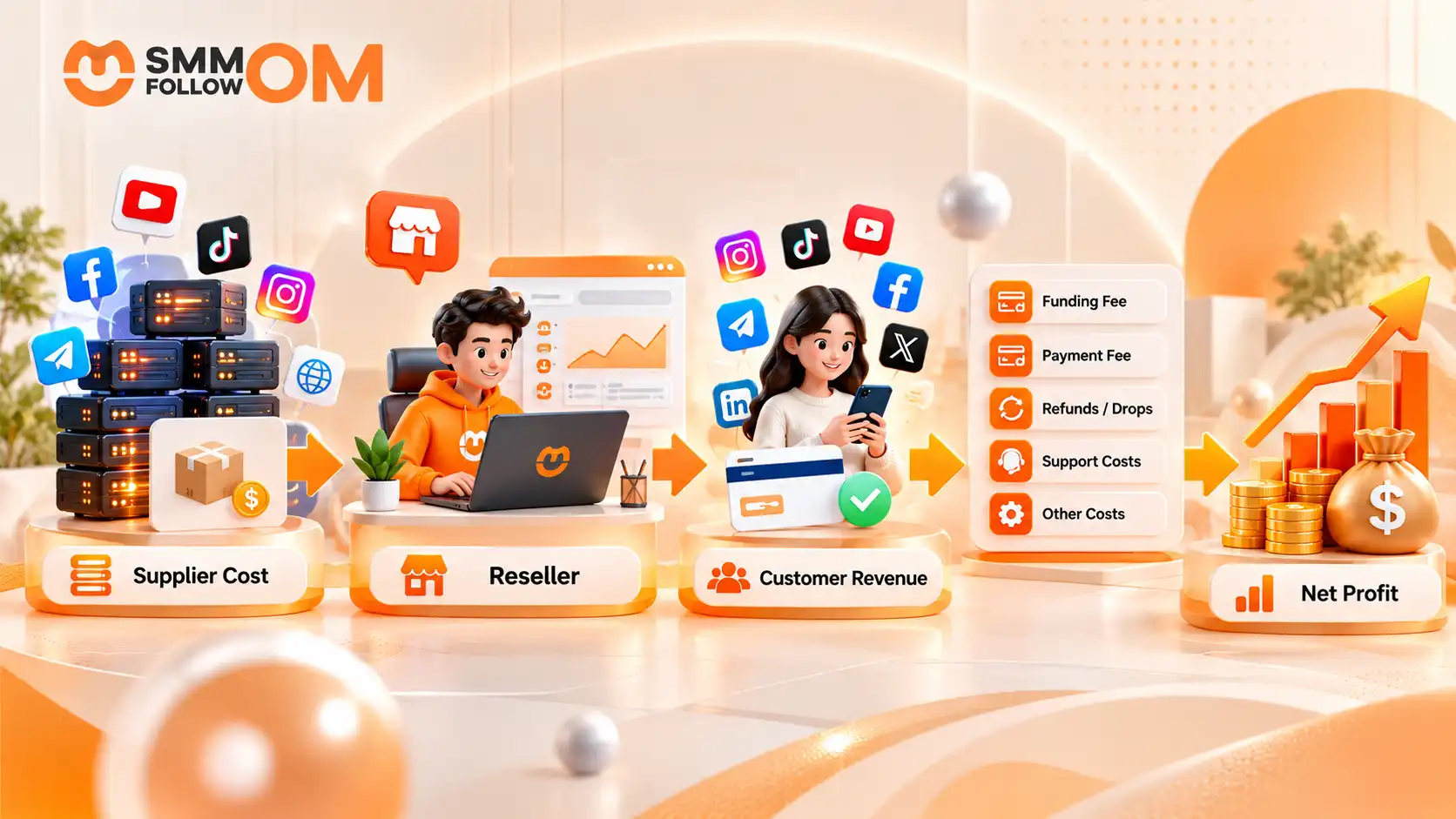
07OCT2026
How to Calculate Profit Margins in the SMM Panel Reselling Industry?
A 100% markup on an SMM service can leave you with a net margin of about 42% once funding and payment fees are counted, and less again after refunds or uncovered drops. The gap between those two numbers is what this guide calculates.
Read More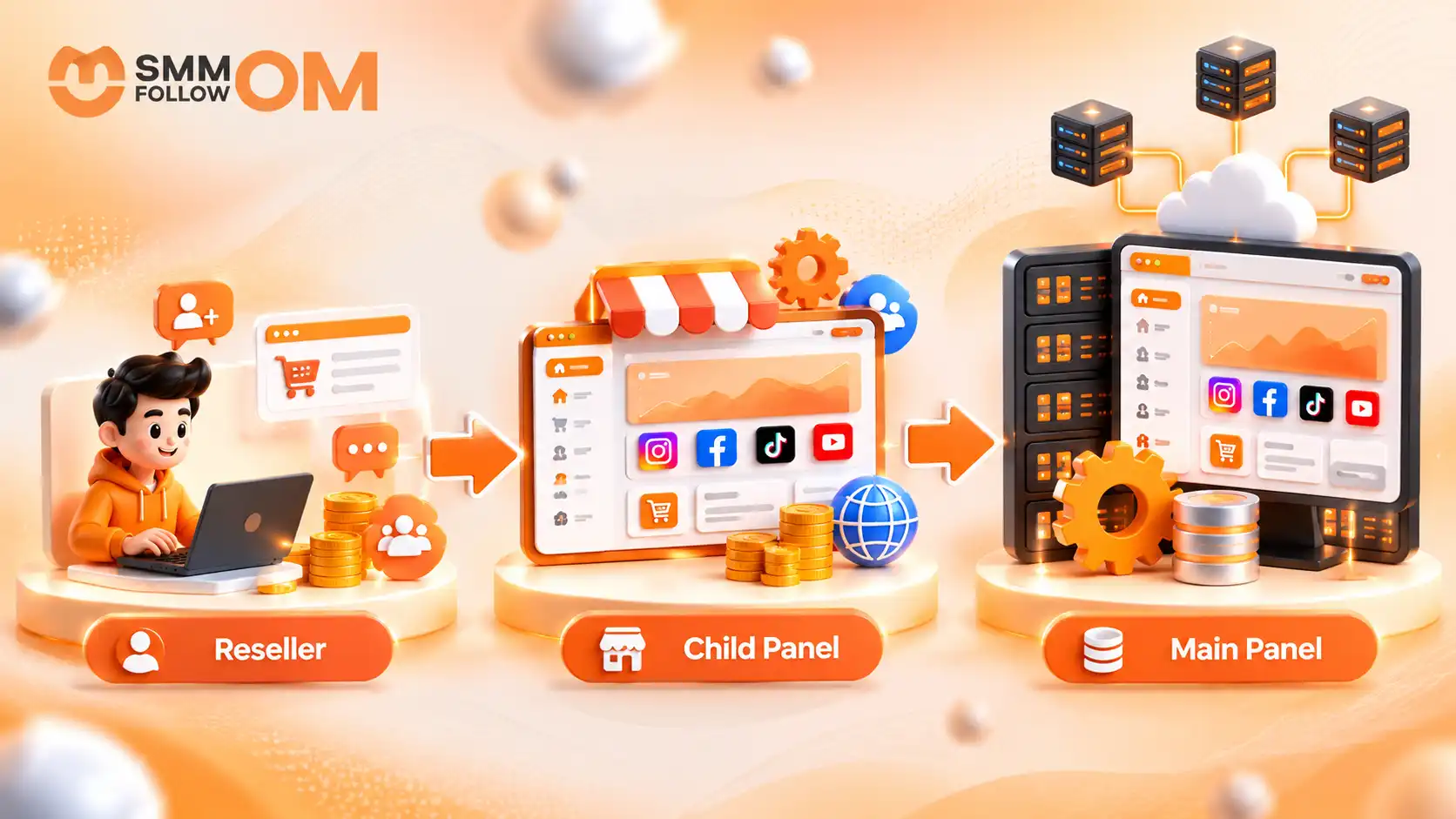
05OCT2026
Main Panel vs Child Panel vs Reseller in SMM: What's the Difference?
In the SMM panel business, a reseller sells another panel's services, a child panel rents a branded storefront from a parent panel, and a main panel runs its own panel software and supplier connections.
Read More