
29SEP2026
Where Do SMM Panel Services Come From?
Table of Contents
Almost none of them come from the panel selling them.
An SMM panel buys delivery capacity from an upstream supplier, marks it up, and lists it under its own service name. That supplier often bought from someone above it. The panel you order from sits somewhere in the chain, and on most panels, it sits nowhere near the top.
This is written for panel owners and resellers choosing suppliers, not for customers placing orders. If you want to know what happens after you click submit, start with How Does an SMM Panel Work.
What follows is what nobody documents: how a service gets found, tested, priced, and listed before a customer ever sees it.
The Supply Chain Has Four Layers
Industry vocabulary is loose, but four positions exist, and knowing which one you are talking to changes everything about the relationship.
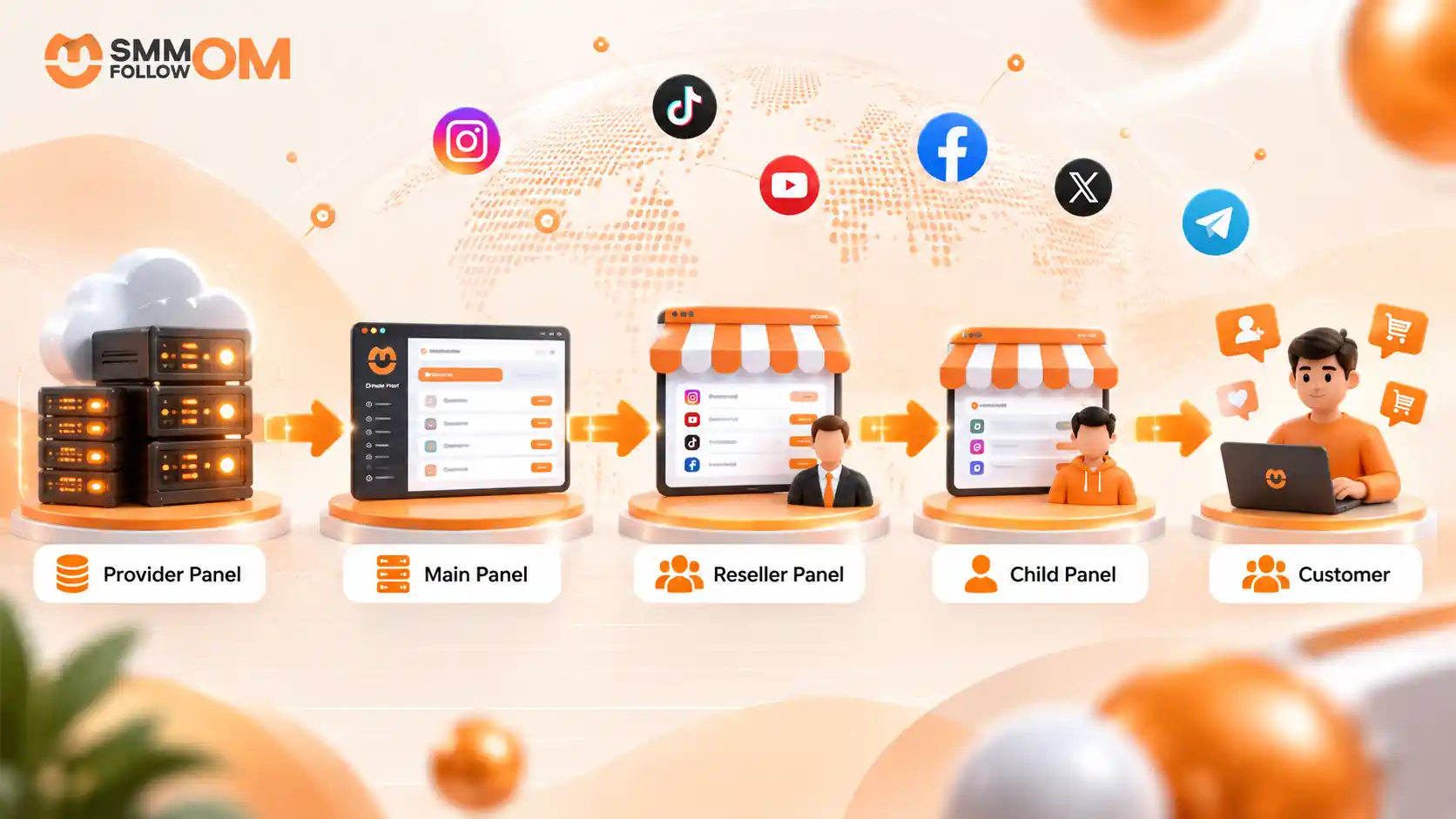
Provider panels sit at the top. They either operate the networks that generate engagement or aggregate directly from the people who do. There are very few of these relative to the number of panels you find on Google.
Main panels buy wholesale from provider panels and supply resellers at scale. They run infrastructure, keep API documentation current, and handle volume. Their customers are mostly other panels rather than end buyers.
Reseller panels buy from a main panel and sell retail. This describes most of the market. A reseller panel runs its own storefront, branding, support and payments, while delivery happens somewhere upstream.
Child panels rent a branded storefront from a parent panel. Own domain, own logo, own prices, someone else's entire backend. The closest comparison is a franchise: you handle customers and pricing, the parent handles delivery and infrastructure.
The honest summary is that nearly everyone in this industry is reselling someone. When two panels quote different prices for what is clearly the same service, you are usually looking at how many layers sit between each one and the source.
Why Main Panels Give Away Child Panels
It looks generous until you see the incentive.
A main panel cannot realistically market in every country and every language. Instead, it lets a hundred resellers do that, each under their own brand, in their own market, at their own prices. Every order those child panels take still lands in the parent's system.
The parent gets distribution it never had to build. The reseller gets a business without development cost. Both sides get something real, which is why the model has lasted.
What the reseller does not get is control. If the parent goes offline, the child panel goes offline. If wholesale rates rise, the margin shrinks overnight with no warning.
How Panels Actually Build a Catalogue
This is more mechanical than most people expect, and it explains a lot.
Panel software like Perfect Panel ships with a bulk import function. You connect a provider's API, pull their entire service list, apply a percentage margin across the whole thing, and publish. A catalogue of two thousand services can exist by the end of an afternoon.
That single feature explains several things you have probably noticed:
- Why so many panels carry near-identical service lists
- Why service names read like they were written by a supplier rather than a marketer
- Why a price can change overnight without anyone touching the panel
- Why service counts run into the thousands on sites with small teams
Bulk import is not a shortcut somebody abused. It is the intended workflow, and it is fine as long as somebody tests what comes through it.
The difference between a panel worth buying from and one worth avoiding usually comes down to whether anyone did.
How Panels Test a Provider Before Listing
A provider's service description is a sales page. What matters is how the service behaves on a real order, and finding that out takes days, not minutes.
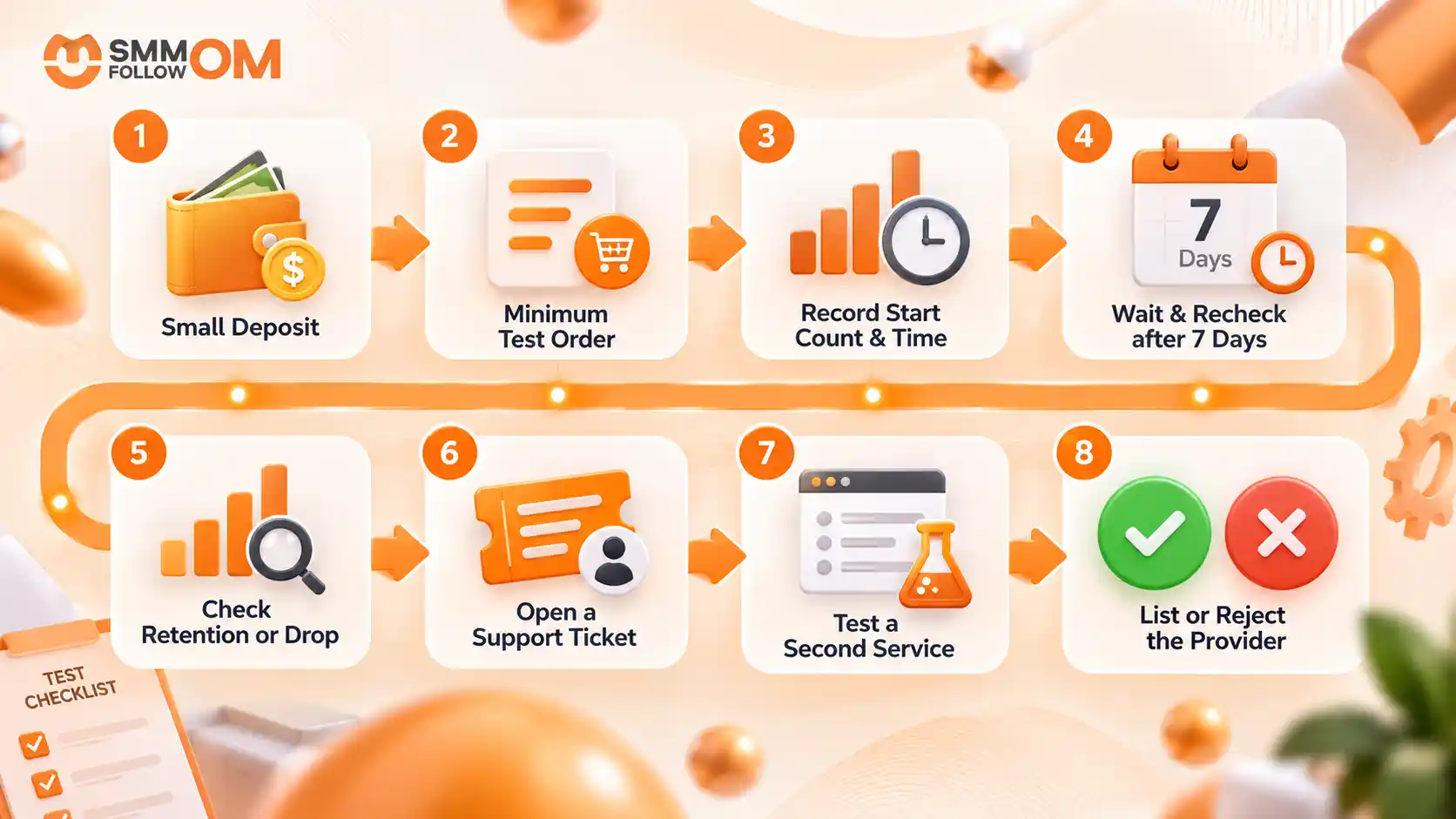
Deposit small. The first deposit only needs to cover a handful of test orders. A provider that disappears with $20 is an annoyance. One that disappears with $500 is a business problem.
Order the minimum on the exact service you plan to list. Not a similar one from the same provider. Delivery source and conditions differ between two listings in the same category, even when the names match.
Record the start count and the clock. Note the count before submitting, and the time the order actually started moving. The listed start time and the real one often disagree, and your customers experience the real one.
Wait seven days, then check again. This step separates a usable service from a cheap one. A count that holds after a week behaves differently from one that falls back within 48 hours, and no service description tells you which you bought.
Open a support ticket before you need one. Ask something ordinary and time the reply. When a real order stalls later, that response time is your only route to fixing it.
Run the same test on a second service. One good result can be luck. Two tells you something about how the provider operates.
A provider that fails any of these is cheaper to drop now than to explain to customers later.
Customers run a version of this same test on the panel itself before trusting it with money — how to choose the best SMM panel walks through what that looks like from their side.
From Provider Service to Your Listing
Once a service passes, the panel maps it into its own catalogue. The upstream might call it:
Service 7421 - IG Followers Global
Your customers see:
Instagram Followers - Global - Standard
Same delivery, different label. The panel controls the presentation layer entirely: where the service appears, how it is categorised, what the description says, how much markup sits on top, whether refill terms are shown, and whether the listing is visible at all today.
That is the real job. A catalogue is not a copy of a provider list. It is an edited version of one, and the editing is where a panel either adds value or hides problems.
Pricing: Where the Number Actually Comes From
Start with the wholesale rate, add margin, publish.
At a provider rate of $0.72 per 1,000 with a 25 percent markup, the customer sees roughly $0.90. Another panel buying the same service applies a different percentage and lands somewhere else entirely.
Beyond the base markup, several things move a retail price:
- The provider raised its own rate
- Currency conversion on deposits and payouts
- Payment processing costs, which vary widely by method
- Support cost, since some services generate far more tickets than others
- How many reseller layers sit above the panel
- Demand, which pushes capacity pricing up during busy periods
So a price gap between two panels does not prove the services differ. Often it only reflects position in the chain and a different view of acceptable margin.
And a cheaper provider is not automatically a worse one. A low wholesale rate can mean an efficient operation close to the source. A high one can mean three resellers stacked on top. Price alone tells you very little about what will actually be delivered, which is the whole reason the testing step exists.
Running More Than One Supplier
Few panels rely on a single provider for a service category, and the reason is availability rather than price.
Suppose two providers both offer YouTube views. One is cheaper but caps at a lower maximum and delivers slowly. The other costs more, handles far larger orders, and starts faster. A panel might list both, or route to the cheap one by default and switch during demand spikes.
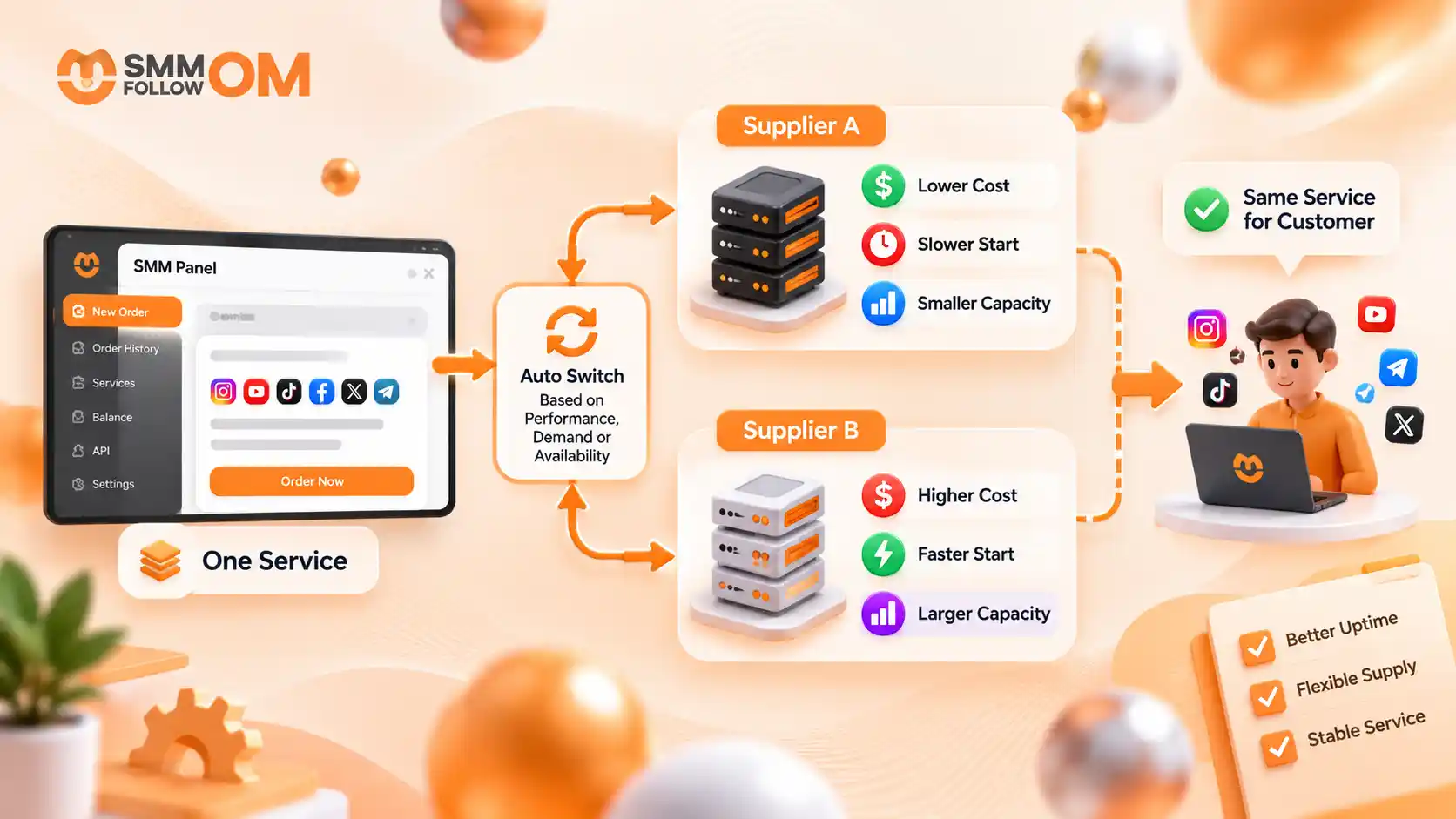
Switching is usually an admin decision rather than something automatic. That is why a service can perform one way this week and differently the next while its name and Service ID never change.
For a customer, that looks inexplicable. From the panel side, it was a Tuesday afternoon decision about capacity.
Why Services Disappear
A listing vanishes for one of two reasons: the provider pulled it, or the panel hid it.
Providers pull services during maintenance, when capacity runs out, when a platform change breaks delivery, or when they replace one source with another. None of that is visible downstream. The service simply stops appearing in the sync.
Panels hide services deliberately too. Failed retests, unstable delivery, a wholesale rate that killed the margin, or a rising complaint volume all justify pulling a listing before it damages anything further.
Either way, the panel is usually still operating normally. One upstream route closed.
What happens next varies. The service returns under the same ID, returns under a new one, gets replaced by a similar listing from another provider, or stays gone.
Monitoring Does Not Stop at Launch
A service that tested well in January can be unusable by June, and nothing announces the change.
The signals worth watching are the ones customers generate:
- Completion rate against total orders placed
- Average start time compared with the listed estimate
- How often orders finish Partial
- Refill requests that fail or go unanswered upstream
- Provider downtime
- Support tickets clustering on one Service ID
When a service starts slipping, the options run from mild to final: update the description to match reality, lower the maximum order size, raise the price to reflect what it now costs, move the listing to a backup provider, or delist it. Customers experience the early stages of this as a stalled or Partial order long before a panel decides to pull the listing. Why SMM panel orders drop or fail breaks down what that looks like on their end.
Catalogues change frequently because the supply underneath them changes frequently. A panel whose catalogue never moves is usually one where nobody is checking.
Why Any of This Reaches the Customer
Customers never see a provider name. They see the results of provider decisions.
A panel running unstable suppliers produces listings that vanish, prices that move without explanation, delivery that works one week and stalls the next, and support that cannot answer questions about its own services.
A panel that tests and monitors produces a smaller catalogue that behaves predictably. Not perfectly. Predictably.
That difference is invisible on a homepage and obvious after three orders.
Final Thoughts
Behind every service listing is a decision somebody made about a supplier: find, test, price, list, watch, replace.
Most panels skip the testing step because bulk import makes it optional. The ones that do not are the ones whose catalogues still work six months later.
Frequently Asked Questions
Can one SMM panel service use more than one supplier?
Yes. Panels commonly keep a primary supplier and at least one backup for the same listing, switching when the main source goes down, hits capacity, or raises its rate past a workable margin. The Service ID stays the same, which is why performance can shift without anything visible changing.
Does my payment go to the upstream provider?
No. You pay the panel, and it credits your balance. The panel maintains a separate account with its providers and pays them from its own funds. Those two money flows never touch.
Can the provider see my panel account?
No. The provider receives the target link, the quantity, and its own Service ID. Your email, your order history and your balance stay inside the panel you ordered from.
What happens if the provider changes its Service ID?
The panel has to update the mapping in its backend. Until it does, orders on that listing fail or route somewhere unintended. The customer-facing service can look completely unchanged while being broken underneath, which is one reason a working service suddenly stops working.
How can I tell whether a panel tested its services?
Read three service descriptions. Real testing produces specific detail: a start time range rather than the word Instant, a stated drop percentage, refill conditions, and what happens when a link changes. Descriptions copied straight from a provider feed read generic across every listing.
Share this on social media




Recently Posted Blogs

19OCT2026
How Much Does Facebook Reels Pay Per 1,000 Views?
You can earn $0.02 to $0.20 per 1,000 views, with many estimates closer to $0.05 to $0.10 per 1,000 Reel views. Numbers above $1 per 1,000 views almost always come from longer videos or a US finance-style audience, not from ordinary Reels. The variation depends on your niche and country. Also, higher numbers may mix Reels earnings with longer-video ad earnings, so they aren't always a good estimate for Reels alone.
Read More
17OCT2026
How to Increase Facebook Followers in 2026: 12 Practical Ways That Actually Help
Increasing Facebook followers is no longer just about posting often. Facebook recommends content based on signals such as what people watch, like, comment on, and show interest in. That means growth depends more on who sees your content, why they visit your Page, and whether they want to follow it.
Read More
15OCT2026
How to Improve Your Facebook Business Page: 13 Practical Steps
Facebook is still the largest social platform in the world, with over 3 billion monthly users at Meta’s last published count. That reach is why the Page itself needs to work, not just the posts you put on it.
Read More