
25SEP2026
Complete SMM Reseller Business Guide: How to Start, Price, Sell, and Scale
Table of Contents
An SMM reseller business works by purchasing social media services from an upstream provider at wholesale rates and selling them to customers at your own price. You can begin manually with a reseller account, move to API automation as order volume grows, or launch a child or white-label panel under your own brand.
The business sounds simple: buy low and sell higher. In practice, sustainable reselling takes more than finding cheap services.
You need to understand supplier quality, working capital, pricing, payment fees, customer support, failed orders, acquisition costs, repeat customers, and automation.
This guide covers the business side from your first provider to scaling a larger reseller operation.
What Is an SMM Reseller Business?
An SMM reseller business, sometimes called an SMM panel reseller business, sells social media services sourced from another provider rather than creating every service directly. The reseller buys at a wholesale rate, adds a markup, manages the customer relationship, and keeps the difference after costs.
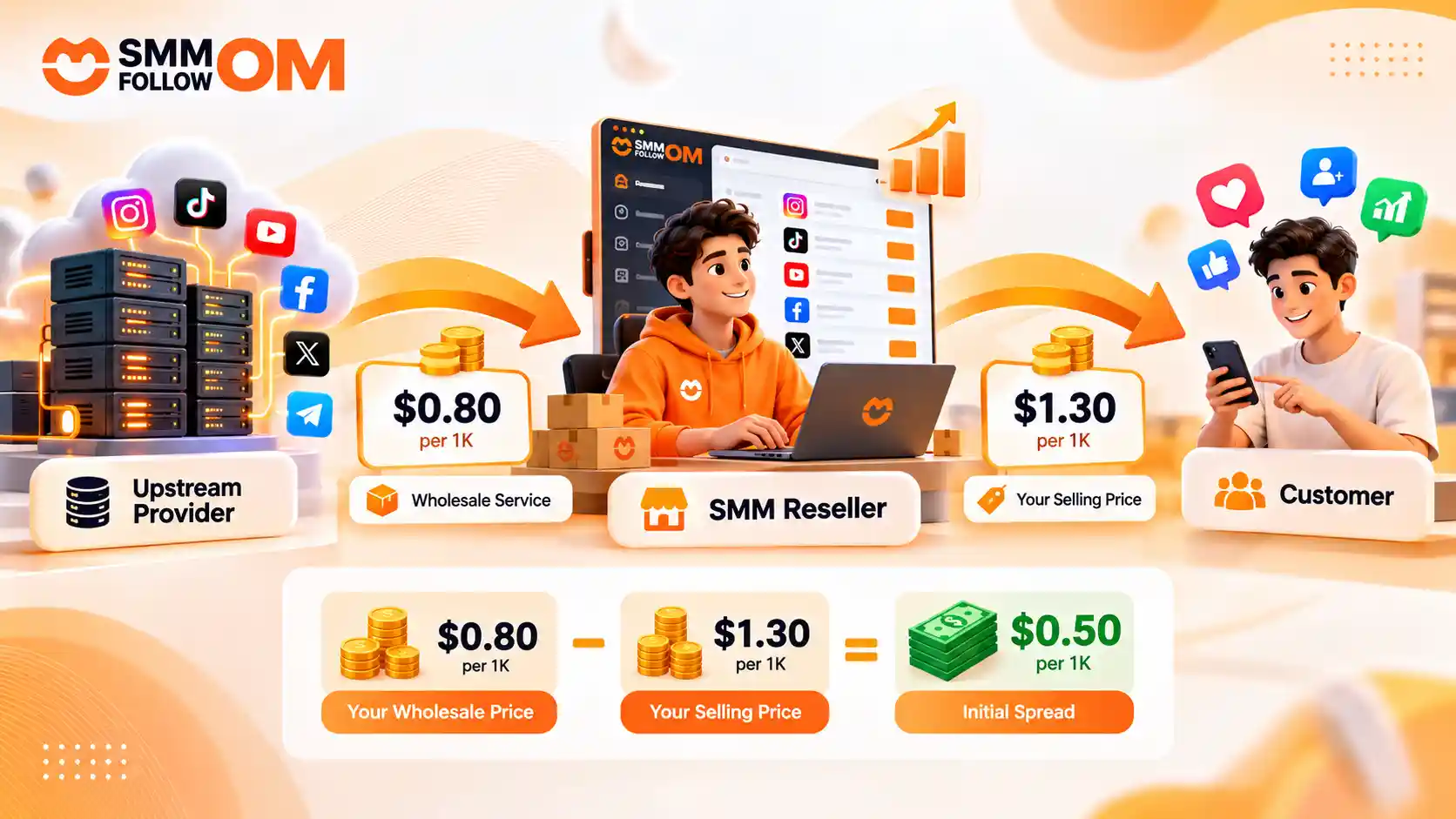
A basic supply chain looks like this:
Upstream Provider → SMM Reseller → Customer
Suppose your provider charges $0.80 per 1,000 for a particular service. You sell it for $1.30 per 1,000. Your initial spread is:
$1.30 − $0.80 = $0.50
That $0.50 is not necessarily your final profit.
You may still need to account for payment fees, refunds, customer acquisition, support costs, currency conversion, software, and other operating expenses.
This is why successful reselling is closer to running a small e-commerce or digital-service business than simply adding a markup to a service list.
Who Can Start an SMM Reseller Business?
The model is particularly relevant to freelancers, social media managers, digital marketers, small agencies, existing SMM panel users, online entrepreneurs, and people who already have clients asking for social media services.
Someone with an existing customer base usually has an advantage.
For example, a freelance social media manager already serving ten businesses does not need to find ten completely new buyers. They may be able to introduce additional services to customers they already know.
A new reseller starting without traffic, clients, or an audience faces a different challenge: customer acquisition may cost more than the services themselves.
Is an SMM Reseller Business Worth Starting?
An SMM reseller business can be viable when you have reliable suppliers, enough margin to absorb operating costs, and a practical way to acquire repeat customers. It becomes much harder when the entire strategy is simply to be the cheapest seller.
The model's appeal is clear.
You do not necessarily need to build the underlying service infrastructure yourself. You can begin with relatively little technical complexity and offer services across several platforms.
But low barriers to entry also create competition.
A reseller charging $1.20 for something available elsewhere for $1.10 needs another reason for customers to stay.
That reason might be:
- easier payments,
- better support,
- clearer service descriptions,
- reliable order handling,
- faster issue resolution,
- useful reseller pricing,
- or a stronger local brand.
A sustainable reseller business therefore competes on value and convenience, not only price.
How Much Money Do You Need to Start an SMM Reseller Business?
You can start an SMM reseller business for about $50 to $115 if you keep the setup simple. This is possible because most reseller businesses don't build their own service infrastructure.
Instead, they buy social media services from an upstream provider at wholesale rates and resell them at a higher price. In many cases, the reseller only needs a panel, a domain, some provider balance, and a way to accept payments.
The actual amount you should invest depends on how professional you want the business to look and how quickly you plan to attract customers. Here is what the startup cost looks like:
A beginner does not necessarily need the larger setup immediately. You can start with a basic reseller account, a small provider balance, and organic customer acquisition. Once you confirm that people are actually buying, you can invest more in branding, automation, paid marketing, and business infrastructure.
What Hidden Costs Can Affect an SMM Reseller Business?
Visible startup costs are only part of the picture. The bigger risk is often cash flow.
Payment Processor Holds
Some payment providers may place restrictions, reserves, or delayed settlements on businesses they consider higher risk. For a reseller, this can create a cash-flow problem. For example:
Customer pays you → payment processor holds part of the money → provider still expects immediate prepaid balance
If too much of your revenue is unavailable while customers continue placing orders, you may run out of usable provider balance even though the business is technically making sales.
This is why working capital matters.
Service Drops and Refill Costs
Another cost can appear after delivery. If a service drops and the upstream provider does not include refill support, you may need to:
- compensate the customer,
- purchase another order,
- issue panel credit,
- or absorb the loss yourself.
That directly reduces your margin.
For this reason, reseller pricing should leave enough room for occasional service problems, rather than using almost the entire markup as expected profit.
Provider Price Changes
Wholesale rates can also change. Suppose your provider increases a service from:
$1.00 to $1.30
but your customer-facing price is still:
$1.20
You are now losing money on every new order.
If your panel does not automatically update or alert you when provider prices change, this can continue until you notice the difference manually.
That is why growing resellers should monitor provider rates closely or use automated price synchronization when possible.
The Practical Budget to Think About
The cheapest setup may require little money, but a healthier starting budget should cover more than the website itself.
You need enough for:
panel setup + provider balance + payment fees + customer acquisition + emergency working capital
Because the goal is not to launch as cheaply as possible. It is to keep fulfilling orders even when payments are delayed, supplier prices change, or a service creates an unexpected support cost.
Where Do SMM Resellers Get Their Services?
SMM resellers usually source services from upstream providers, direct suppliers, reseller panels, or a mix of several providers.
A reseller may use one supplier for Instagram, another for YouTube, and a third for Telegram. The key business question is not simply:
“Who is cheapest?”
It is:
“Which provider leaves enough margin while remaining stable enough for my customers?”
Direct Provider vs Reseller Provider
A direct provider is generally closer to the original service source. A reseller provider buys from someone upstream and sells again. That extra layer may increase the cost, but it can also provide benefits such as easier payments, better support, or a larger combined catalog.
For reseller businesses, what matters most is overall economics and reliability.
A slightly more expensive provider that resolves problems quickly may be more profitable than a cheaper supplier that creates constant support tickets.
Which Setup Should an SMM Panel Reseller Use: Account, API or Child Panel?
A reseller account is best for learning and validating demand, API automation is useful when manual order handling becomes inefficient, and a child or white-label panel is better when you want your own branded customer experience.
Start With a Reseller Account If...
You are still learning which services customers actually want. Manual operation makes it easier to understand:
- provider behavior,
- customer questions,
- pricing,
- refill requests,
- and support problems.
You gain operational experience before automating mistakes.
Move to API Automation When...
Automation becomes useful when manual processing starts consuming too much time. For example, if you are receiving dozens of daily orders, manually copying each target, quantity, and provider Order ID becomes inefficient.
An API can connect your system with the provider so supported orders and statuses can move between systems automatically.
For a reseller, the main benefit is simple:
less repetitive manual work.
Read What Is an API in SMM Panel? To understand the API clearly.
Use a Child Panel When...
A child or white-label panel makes more sense when you want customers to order directly under your own brand. It can provide:
- your domain,
- your logo,
- your retail pricing,
- customer accounts,
- order history,
- payment options,
- and a branded dashboard.
It does not remove the need for upstream suppliers. It changes the customer-facing layer of the business.
Our child panel program handles the backend so you only manage pricing and customers.
How Should an SMM Reseller Price Services?
An SMM panel reseller should set prices by adding a sustainable markup to the provider’s wholesale rate while accounting for order volume, payment fees, operating costs, and the profit margin they want to keep.

A useful formula is:
Selling Price = Provider Cost + Payment Cost + Operating Cost + Risk Allowance + Profit
Suppose:
Provider cost = $1.00
Payment cost = $0.05
Operating allocation = $0.10
Risk/refund allowance = $0.05
Desired profit = $0.30
Your selling price becomes:
$1.50
If you sell the service for $1.10 just because another panel does, your apparent margin may disappear once the other costs arrive.
Markup Is Not Margin
A 50% markup and a 50% margin are different numbers, and mixing them up is one of the fastest ways to underprice. If a service costs you $1.00 and you add a 50% markup, you sell at $1.50 and keep $0.50, which is a 33% margin. To keep a 50% margin, you have to sell at $2.00, which is a 100% markup.
Decide which one you are targeting before you build your price list.
How Much Profit Can an SMM Reseller Make?
Profit depends on order volume, average order value, provider costs, customer acquisition, payment fees, refunds, and repeat purchases. Revenue alone does not show whether the business is healthy.
Use:
Net Profit = Revenue − Provider Costs − Payment Fees − Marketing − Refunds − Operating Costs
Suppose a reseller processes:
100 orders per month
Average order value:
$15
Monthly revenue:
$1,500
Assume:
Provider costs = $850
Payment fees = $75
Marketing = $200
Refunds/adjustments = $50
Other operating costs = $125
Net profit:
$200
The business generated $1,500 in revenue, but only $200 remained.
That is why revenue screenshots are not enough to evaluate a reseller business.
Metrics Every Reseller Should Track
A reseller should monitor:
A reseller who tracks these numbers can make better decisions than one who looks only at sales.
What Payment Methods Should an SMM Reseller Offer?
Offer SMM payment methods that your target customers actually use while accounting for transaction fees, settlement time, refunds, and merchant eligibility.
A local reseller may prioritize local payment methods. An international reseller may need cards, bank options, supported digital wallets, or other suitable gateways. The exact mix depends on:
- geography,
- customer type,
- business eligibility,
- payment fees,
- settlement,
- and refund handling.
The best payment gateways for SMM panels compares the main options by country, fee and merchant eligibility.
How Does an SMM Reseller Handle Customer Orders?
A reseller receives the customer's order, sends or routes it to the upstream provider, monitors the provider response, and communicates the final status to the customer.
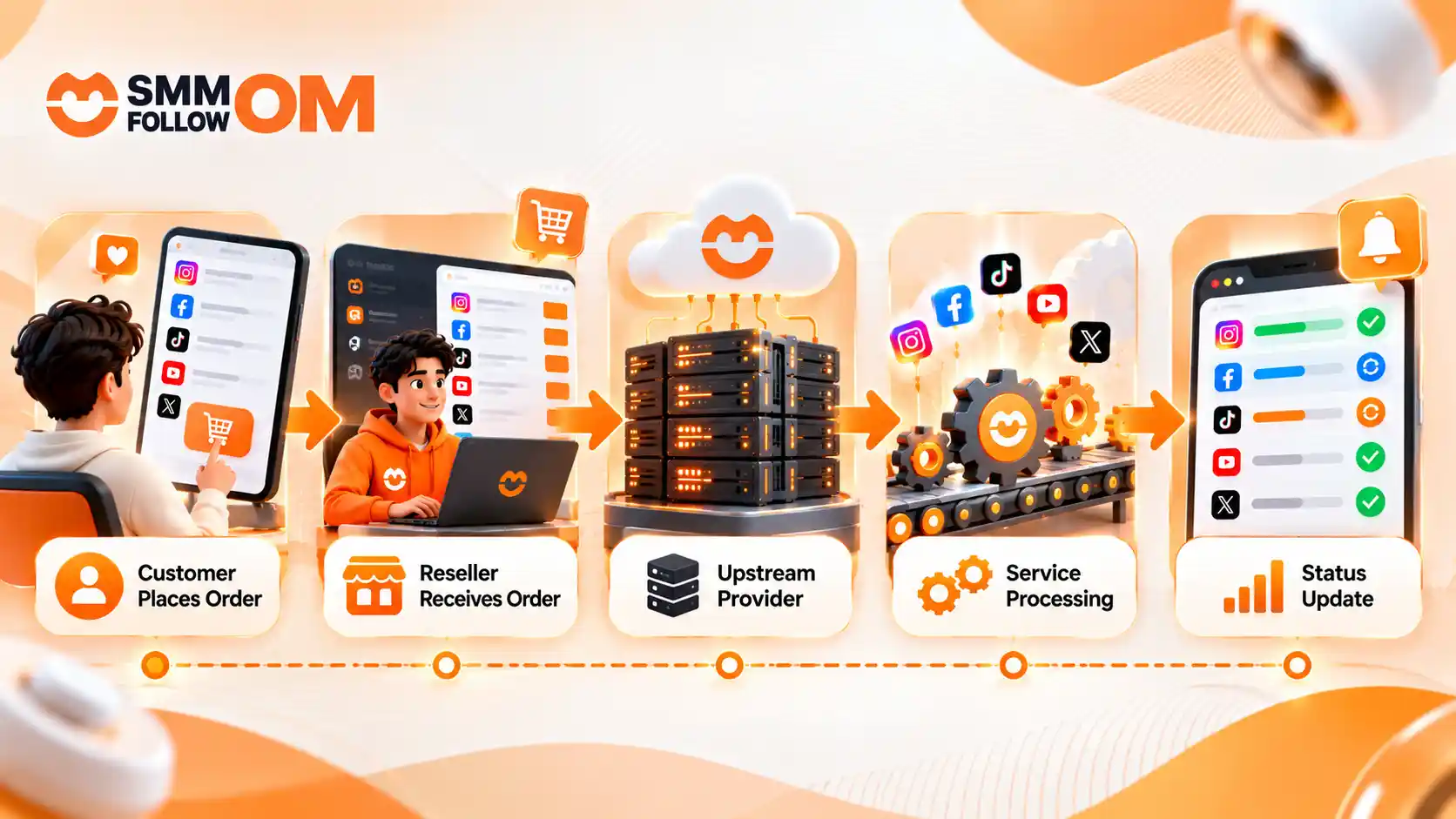
At low volume, this can be manual. At higher volume, automation becomes useful.
Manual Order Handling
A small reseller may manually:
- receive the customer request,
- select the supplier service,
- enter the target,
- enter the quantity,
- place the provider order,
- store the provider Order ID,
- and update the customer later.
This is manageable for ten orders.
It becomes tedious for hundreds.
Automated Order Handling
With compatible API integration, supported orders can move automatically from the reseller system to the provider. Statuses can also be synchronized.
This is where automation starts to affect scalability. However, automation does not remove supplier risk. A bad service automated perfectly is still a bad service.
What About Partial, Cancelled, or Failed Orders?
Handle these situations through a defined customer-service process. For example:
Customer Order → Provider Review → Partial/Cancel Result → Balance Adjustment or Support Action
The reseller needs to communicate clearly instead of leaving the customer guessing.
Here, the business lesson is simpler: have a procedure before the first problem happens.
How Should an SMM Reseller Handle Customer Support?
A reseller should define support, refund, refill, cancellation, and escalation rules before order volume grows. Good support protects customer retention and prevents small provider issues from becoming larger disputes.
A simple operation might define:
- expected first-response time,
- when a provider ticket should be opened,
- when balance credit applies,
- how refill requests are handled,
- what information customers need to provide,
- and which situations cannot be refunded.
Without clear rules, every ticket becomes a new decision.
Don't Promise What Your Provider Cannot Control
One common reseller mistake is overselling. Avoid turning limited service conditions into promises such as:
“Guaranteed viral.”
“Permanent forever.”
“Guaranteed sales.”
The reseller becomes responsible for explaining the difference between a service-level commitment and a wider marketing outcome.
What a panel can and cannot promise is covered in " Do SMM panels guarantee results.
How to Get Customers for an SMM Reseller Business
The strongest reseller acquisition strategy usually combines existing relationships, search traffic, content, referrals, outreach, and repeat customers, rather than relying on a single channel.
Getting customers is often harder than sourcing services.
A reseller with excellent suppliers but no distribution still has no business.
How to Get Your First 10 Customers
Your first customers do not need to come from large advertising campaigns. Start with places where trust already exists.
For example:
- existing freelance clients,
- agency relationships,
- digital marketing contacts,
- creator communities,
- referrals,
- direct outreach,
- or people already asking you for social media help.
The goal at this stage is not maximum volume.
It is to learn:
What do customers actually buy?
You may discover that customers consistently ask for three services while ignoring 200 others. That information should shape your catalog.
Use SEO to Capture Existing Demand
SEO works particularly well when people already search for what you sell.
A reseller may build pages around commercial searches such as:
- SMM panel
- Instagram SMM services
- buy Instagram followers
- buy YouTube views
- cheap SMM services
- social media promotion services
The goal is not to create hundreds of thin landing pages.
Build useful pages for actual customer questions and service categories.
Search is only one channel, and the slowest to pay off. Once your first customers are in, testing outreach, referrals and community work alongside SEO shows you which source brings buyers who come back, not just signups.
Use Content to Build Trust
Informational content can support commercial pages.
Examples include:
- how services work,
- pricing explanations,
- refill explanations,
- order troubleshooting,
- platform guides,
- provider education,
- and reseller guides.
This helps a panel become more than a list of services.
Referrals and Repeat Orders Matter
A customer who returns ten times can be much more valuable than ten customers who order once.
This is why reseller growth should track:
customer lifetime value, not only new registrations.
A referral program, reseller discount, volume tier, or good support experience can help increase repeat business.
How to Keep Customers Coming Back?
Customer retention depends on predictable service, clear communication, sensible pricing, easy payments, and resolving problems without creating unnecessary friction.
Resellers often focus too much on getting new customers. But repeat customers are usually cheaper to serve because you do not need to acquire them again. Imagine:
Customer acquisition cost = $10
First-order profit = $4
If the customer buys once, the economics are poor.
If the same customer generates $40 in profit over several months, the original $10 acquisition cost looks very different.
That relationship between CAC and customer lifetime value is one of the most important ideas in scaling.
What Are the Biggest Risks in an SMM Reseller Business?
The biggest business risks are supplier dependency, unstable pricing, thin margins, refunds, customer disputes, payment restrictions, and changes in platform or provider conditions.
Supplier Risk
If one supplier powers most of your catalog, their problems become your problems. A provider going down on a Friday night becomes your support queue on Saturday morning.
Margin Risk
Suppose your provider increases a service from:
$1.00 to $1.35
but your customer price remains:
$1.40
Your margin has nearly disappeared. Resellers need a system for monitoring supplier-price changes.
Refund and Customer Dispute Risk
Customers may request refunds because:
- they misunderstood the service,
- delivery changed,
- the provider had a problem,
- or they expected something the service never promised.
Clear descriptions and policies reduce these disputes.
Platform and Payment Policy Risk
Social platforms and payment companies maintain their own policies.
A reseller should verify that its services, payment methods, and marketing claims fit the relevant rules, rather than assuming that a provider's availability means universal acceptance.
What Policies Should an SMM Reseller Business Have?
At minimum, a reseller should clearly explain payment terms, refunds, cancellations, refill conditions, service limitations, customer responsibilities, and privacy.
Policies are not decorative pages. They reduce confusion. For example, your refund policy should explain whether an incomplete provider order results in:
- original-payment refund,
- panel-balance credit,
- Partial adjustment,
- or another process.
Your refill policy should explain:
- eligible services,
- refill window,
- exclusions,
- and how requests are submitted.
The customer should know these conditions before paying, not after something goes wrong.
How to Scale an SMM Reseller Business?
Scaling means increasing profitable order volume without allowing support costs, supplier problems, or customer acquisition expenses to grow faster than revenue.
More orders alone are not successful scaling. If sales double while refunds and support costs triple, the business may become worse.
Add More Suppliers, Not Just More Services
A catalog with 5,000 services is not necessarily stronger than one with 500 reliable services. Supplier redundancy is often more useful than endlessly increasing catalog size. For important categories, maintain alternatives.
Introduce Customer Pricing Tiers
Different customers have different economics. You might offer:
Retail: standard price
Reseller: lower price after a volume threshold
Agency: custom rates for recurring volume
VIP: negotiated pricing for large customers
This helps you protect margins while rewarding volume.
Increase Average Order Value
Growth does not always require more customers. You can increase revenue per customer through relevant:
- bundles,
- volume pricing,
- cross-selling,
- agency packages,
- and multi-platform offers.
The key word is relevant. Don't push services just because they exist.
Before increasing marketing spend, check the metrics listed earlier. If they are weak at 100 monthly orders, scaling to 1,000 amplifies the weakness.
How to Start an SMM Reseller Business in 5 Stages
You can build a practical reseller business in five stages.
Stage 2 is also when the website itself takes shape. Once you know what to sell, this checklist of the 15 pages every SMM website needs covers what the site should include: pricing, sign-up, policies, and support before you start building it.
Final Thoughts
Most people who quit this business did not pick the wrong provider. They priced against a competitor instead of against their own costs, then ran out of working capital when a payment settlement got held up.
So know what an order actually leaves you after fees, refunds, and support time. That number decides whether you have a business or an expensive hobby.
Frequently Asked Questions
Do I need my own SMM panel to become an SMM panel reseller?
No. You can begin by reselling services manually through an existing provider account. A branded panel becomes more useful when you have enough customers and order volume to justify it.
Can I start an SMM reseller business without coding?
Yes. A basic reseller business can operate without programming. Child panels and existing panel software can also reduce the technical work required. Coding becomes more relevant when you want custom integrations or automation.
How many providers should an SMM reseller use?
There is no fixed number. A beginner may start with one or two suppliers, while a larger reseller may maintain several providers and backup routes. The goal is enough redundancy without making supplier management unnecessarily complicated.
Should I sell every service my provider offers?
Usually not. A smaller catalog of tested, understandable services can be easier to price, support, and manage than thousands of listings that you have never evaluated.
How often should I update reseller prices?
Review prices whenever provider costs change significantly and check important services regularly. High-volume or volatile services may need more frequent monitoring than stable ones.
Share this on social media




Recently Posted Blogs

13OCT2026
How to Monetize a Facebook Page: Requirements, Methods & Earnings
To monetize a Facebook Page, use a Page or a profile in Professional Mode, stay within Meta’s monetization policies, and turn on whichever tools your Monetization dashboard unlocks: Content Monetization (invite-based), Stars (500 followers for 30 days), Subscriptions, or paid brand partnerships.
Read More
11OCT2026
How Can an SMM Reseller Build Passive Income Without Their Own Panel?
An SMM reseller builds passive income by handing the repeated parts of every sale to automation: a chatbot takes the order, a supplier API places it, prepaid credit removes payment checks, and alerts bring only the problems to you. The result is semi-passive, not hands-off. Once it runs, a reseller handling 30 orders a day spends minutes on the business instead of hours.
Read More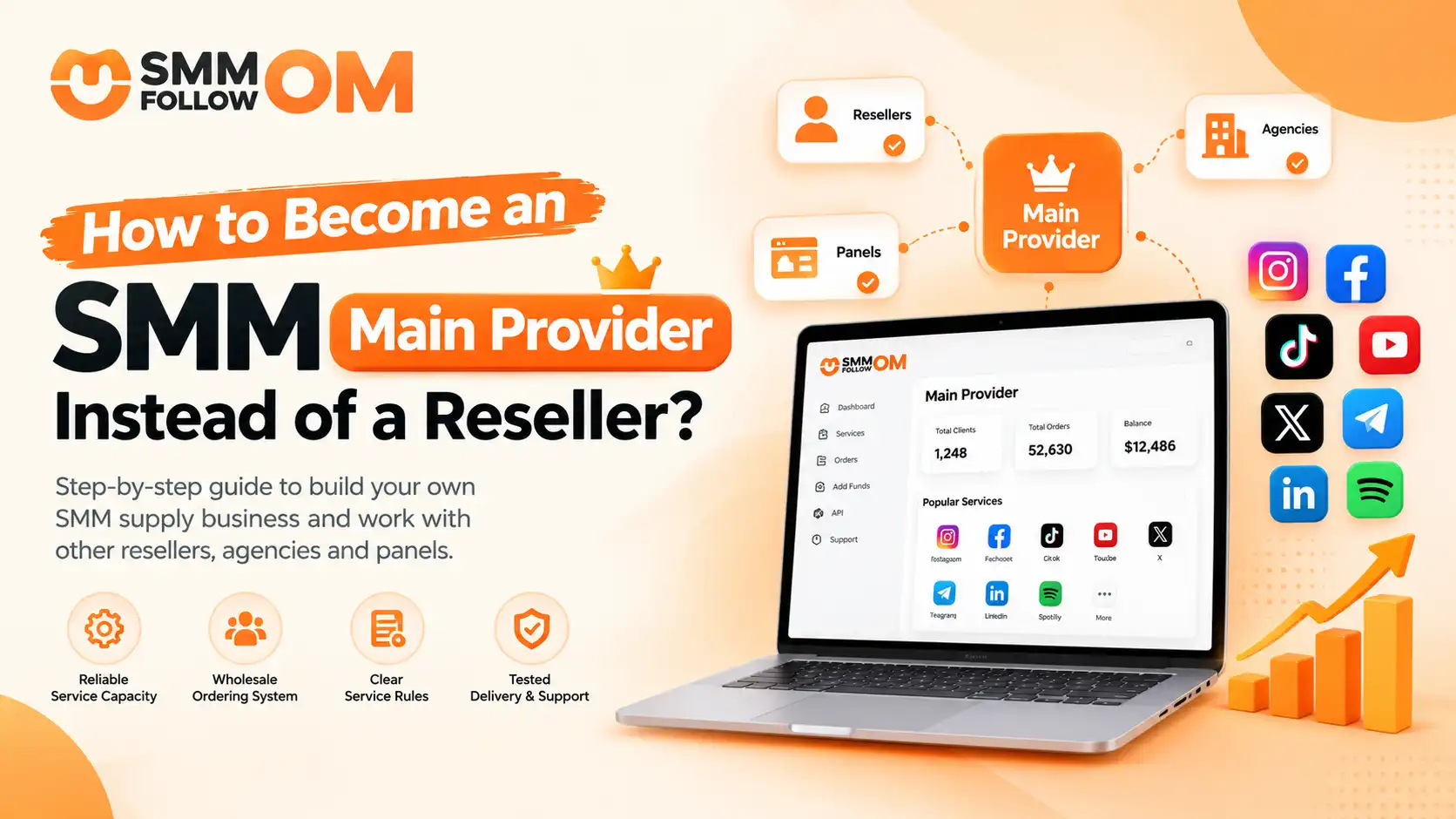
09OCT2026
How to Become an SMM Main Provider Instead of a Reseller?
Becoming an SMM main provider means moving from buying services for resale to supplying services that other resellers, agencies, or panels can depend on. You need reliable service capacity, a wholesale ordering system, clear service rules, tested delivery, and a process for handling problems before you can scale.
Read More